


How Do RS-485 to Ethernet Converters Work in Solar Power Monitoring Systems
Solar power systems use many devices that communicate using RS-485. In a solar array, inverters, meters, battery controllers, and weather stations often use RS-485. These devices send data in Modbus RTU or other serial formats. But modern monitoring platforms rely on Ethernet and IP networks.
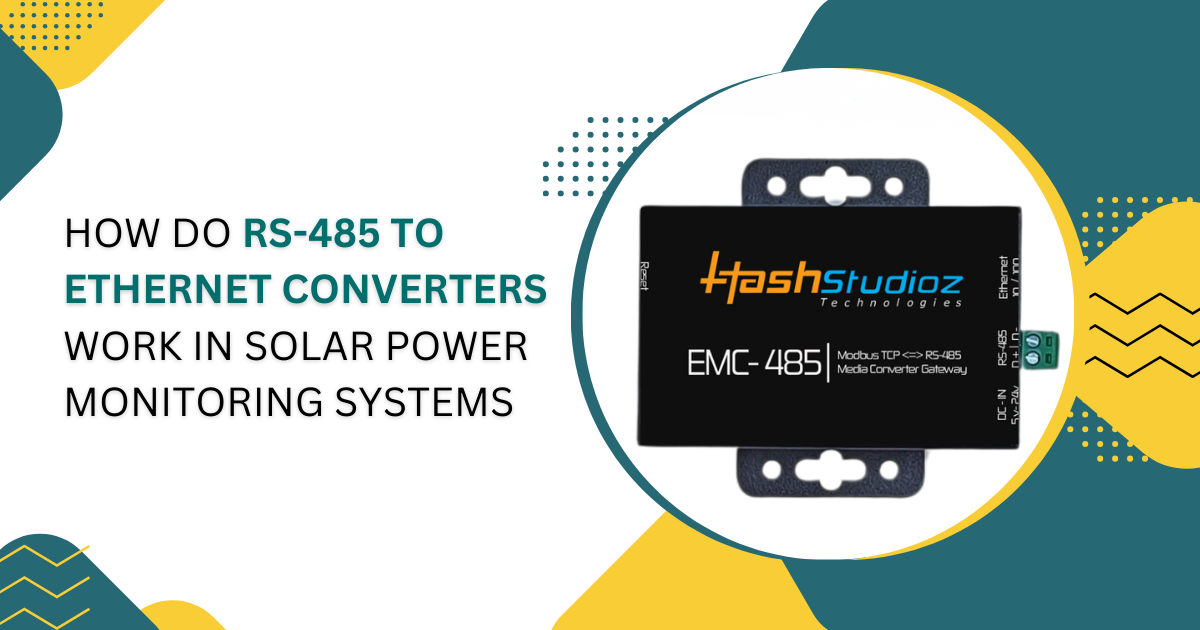
An RS-485 to Ethernet Converter bridges this gap. It converts serial signals into TCP/IP packets. It lets RS-485 devices connect to routers, switches, or cloud platforms. This article explains how these converters work in solar monitoring systems. It also shows why they matter for reliability, performance, and cost.
Why Solar Monitoring Needs RS-485 and Ethernet
1. RS-485 Enables Field-Level Communication
RS-485 supports long cable runs and daisy-chain wiring, allowing inverters, meters, and sensors to connect reliably across large solar arrays. Its differential signaling resists electrical noise, making it ideal for outdoor, high-voltage environments where stable communication is critical.
2. Ethernet Enables Modern Data Infrastructure
Ethernet connects solar sites to servers, SCADA systems, and cloud platforms. It supports high-speed, low-latency transmission, enabling real-time analytics, dashboards, and remote control. Ethernet is the backbone of modern IT networks, ensuring data is accessible and scalable.
3. RS-485 Is Cost-Effective for Large Installations
RS-485 uses minimal wiring and simple topology, reducing installation and maintenance costs in solar farms. One bus can support multiple devices, eliminating the need for expensive point-to-point cabling. This makes it the most economical choice for field device connectivity.
4. Ethernet Enables Remote Monitoring & Maintenance
Ethernet allows operators to access system performance from anywhere, enabling fast fault detection, remote troubleshooting, and firmware updates. This reduces downtime and maintenance costs, improving overall solar plant reliability and efficiency.
5. Converters Bridge the Protocol Gap
Most solar devices communicate via RS-485, while monitoring platforms use Ethernet. A gateway converter translates RS-485 protocols (Modbus, etc.) into Ethernet packets, enabling seamless integration. Without it, field devices cannot communicate with modern monitoring systems.
What Is an RS-485 to Ethernet Converter?
An RS-485 to Ethernet Converter converts serial data to Ethernet data. It sends serial frames as TCP/IP packets. The converter can also receive TCP packets and send them over RS-485. Some converters also support Modbus TCP and Modbus RTU. This makes integration easier. The same device may be marketed as an RS-485 to LAN Converter. Both terms describe the same function.
How the Converter Works: The Core Process
1. Receiving Data from RS-485 Devices
The converter connects to solar devices (inverters, meters, sensors) using RS-485 wiring. It listens to the serial communication and captures the data packets transmitted by these devices using protocols like Modbus RTU.
2. Data Interpretation and Parsing
Once the data arrives, the converter interprets the RS-485 signals and decodes the packet structure. It identifies device addresses, function codes, and data registers, ensuring the information is valid and complete before conversion.
3. Protocol Translation
The converter translates RS-485 protocols (commonly Modbus RTU) into Ethernet-based protocols (such as Modbus TCP). This conversion adapts the data format and communication rules to match network-based monitoring systems.
4. Packaging Data for Ethernet
After translation, the converter packages the data into Ethernet frames or TCP packets. It adds necessary headers, IP addressing, and port information to ensure the monitoring platform can receive and understand the data.
5. Sending Data to Monitoring Systems
The converter sends the Ethernet packets through LAN or internet connection to monitoring platforms, SCADA systems, or cloud servers. The monitoring system then displays real-time solar performance, alarms, and energy reports.
Key Features That Matter in Solar Systems
1. Support for Multiple Devices
A single RS-485 bus can connect many devices. Converters often support multiple ports or multiple channels. This lets you connect:
-
Inverters
-
Energy meters
-
Battery controllers
-
Weather stations
2. Modbus RTU to Modbus TCP
Most solar devices use Modbus RTU. Many monitoring systems use Modbus TCP. A converter translates between the two.
Example:
A solar inverter sends a Modbus RTU response.
The converter wraps it in a TCP packet.
The monitoring server reads it as Modbus TCP.
3. Isolation and Surge Protection
Solar farms face high electrical noise and lightning risk.
Converters often include:
-
3 kV isolation
-
Surge protection
-
Transient voltage suppression (TVS)
This protects the Ethernet network and monitoring equipment.
4. Power Supply Options
Converters can run on:
-
12V DC
-
24V DC
-
48V DC
Some models support wide voltage ranges for industrial use.
How Data Flows in a Solar Monitoring System
1. Data Generation at Solar Field Devices
Solar devices such as inverters, energy meters, and weather sensors continuously generate performance data. This includes voltage, current, power, energy output, temperature, and fault codes. These devices typically communicate using RS-485 protocol.
2. RS-485 Communication to Gateway
The field devices send their data through RS-485 cabling to a central gateway or converter. RS-485 is preferred for its long-distance capability and noise resistance, ensuring reliable data transfer across large solar farms.
3. Data Conversion at the Gateway
The gateway receives RS-485 signals and converts them into Ethernet-compatible formats. It translates protocols like Modbus RTU into Modbus TCP or other Ethernet-based protocols, preparing the data for network transmission.
4. Ethernet Transmission to Local Network
Converted data is sent over Ethernet (or Wi-Fi) to a local network router or switch. Ethernet provides higher speed and stable connectivity, enabling real-time data transfer and remote access.
5. Data Aggregation and Local Storage
The monitoring system collects and aggregates data from multiple gateways. Data can be stored locally in a server or on an edge device for quick access, trend analysis, and backup before sending to the cloud.
Example Setup
A typical system includes:
-
Solar inverter with RS-485 output
-
RS-485 cable to converter
-
Converter connected to Ethernet switch
-
Ethernet switch connects to router
-
Router connects to monitoring server or cloud
Data Flow Steps
-
The inverter sends Modbus RTU data over RS-485.
-
The converter reads the RS-485 frame.
-
The converter builds a Modbus TCP packet.
-
The packet travels over Ethernet.
-
The monitoring system receives the packet.
-
Data is displayed in dashboards or stored in databases.
This flow happens continuously, often every 5 to 60 seconds.
Why RS-485 to Ethernet Converters Improve Solar Monitoring
1. Long-Distance Connectivity
RS-485 supports long cable runs. Ethernet typically does not. Converters allow the RS-485 bus to reach the inverter. Ethernet handles the rest of the network.
2. Cost Savings
Using RS-485 for field devices saves wiring costs. RS-485 cables are cheaper than fiber or long Ethernet runs.
3. Centralized Monitoring
Ethernet lets you connect many devices to one monitoring server. This centralizes data collection and analysis.
4. Remote Access
Ethernet enables remote troubleshooting and updates. Operators can access inverter data without visiting the site.
Key Technical Specifications to Check
When choosing a converter, review these specs:
RS-485 Specs
-
Maximum bus length
-
Maximum device count
-
Baud rate range
-
Isolation rating
Ethernet Specs
-
Data rate (10/100 Mbps)
-
Protocol support (TCP/UDP)
-
Static IP and DHCP
-
Web-based configuration
Environmental Specs
-
Operating temperature
-
Humidity range
-
Vibration tolerance
-
Enclosure type (DIN rail, IP65)
Performance Example With Real Numbers
A medium solar farm may have:
-
10 inverters
-
2 energy meters
-
1 weather station
Each device reports data every 10 seconds.
Each message size averages 120 bytes.
Data Rate Calculation
-
13 devices × 120 bytes = 1,560 bytes per cycle
-
Every 10 seconds → 156 bytes per second
-
That equals about 1.25 kbps
This load is small for Ethernet. Even a 10 Mbps link handles it easily. The key benefit lies in the converter’s ability to handle many serial devices and forward them efficiently.
Common Issues and How Converters Solve Them
Issue 1: Signal Noise on RS-485
Solar farms face EMI from inverters and cables.
Converters with isolation and surge protection reduce data loss.
Issue 2: Protocol Mismatch
Many devices use Modbus RTU.
Monitoring systems use Modbus TCP.
Converters translate between these protocols.
Issue 3: Long Cable Runs
RS-485 works well over long distances. Ethernet does not.
Converters allow RS-485 to reach the field, while Ethernet stays in the control room.
Choosing the Right Converter
Consider These Questions
-
How many RS-485 devices will connect?
-
What baud rate do devices use?
-
Will you use Modbus RTU or a custom protocol?
-
Do you need surge protection?
-
What is the site temperature range?
Example Selection Criteria
If you need to connect 20 devices and you want remote access, choose a converter with:
-
Multiple RS-485 channels
-
Modbus TCP support
-
Web-based management
-
High isolation rating
-
Wide temperature range
Installation Best Practices
RS-485 Wiring Tips
-
Use twisted-pair cable
-
Add termination resistors at both ends
-
Keep A and B lines correct
-
Use shielded cable for long runs
-
Ground only at one point
Ethernet Network Tips
-
Use industrial switches
-
Add surge protectors for outdoor networks
-
Keep network paths short and simple
-
Use VLANs for security
Security Considerations
Converters connect field devices to IP networks. Security matters. Common measures include:
-
Strong passwords
-
Firewall rules
-
VLAN separation
-
VPN access
-
Firmware updates
Without security, attackers can access critical energy infrastructure.
Use Cases in Solar Power Systems
Case 1: Residential Solar Monitoring
A home inverter uses RS-485.
The converter sends data to a local router.
The homeowner checks performance via an app.
Case 2: Commercial Rooftop System
A rooftop solar system has multiple inverters.
The converter connects them to the building network.
Facility managers view data on a SCADA system.
Case 3: Utility-Scale Solar Farm
Large solar farms use multiple RS-485 buses.
Converters connect each bus to a central control room.
Operators monitor output, faults, and efficiency.
Comparison: RS-485 vs Ethernet in Solar Systems
|
Feature |
RS-485 |
Ethernet |
|
Distance |
Up to 1,200 m |
Up to 100 m (without repeaters) |
|
Device Count |
Up to 32 per bus |
Many devices with switches |
|
Noise Immunity |
High |
Medium |
|
Protocol |
Serial |
IP-based |
|
Installation Cost |
Low |
Higher |
Converters combine the strengths of both.
Final Summary
An RS-485 to Lan Converter enables modern solar monitoring. It connects legacy serial devices to IP networks. The converter reads RS-485 data, wraps it into TCP/IP packets, and sends it over Ethernet. It supports Modbus RTU and Modbus TCP. It also offers isolation and surge protection.
In solar systems, converters improve reliability, reduce costs, and support remote monitoring. They help connect inverters, meters, and controllers to central servers and cloud platforms. For solar farms, this conversion is essential for efficient and scalable monitoring.

 English
 Arabic
 French
 Spanish
 Portuguese
 Deutsch
 Turkish
 Dutch
Dutch
 Italiano
 Russian
 Romaian
 Greek
Greek
