Enterprise hiring is no longer just about posting jobs and collecting resumes. Today, recruitment teams operate like high-performance revenue functions. They manage multiple departments, hiring managers, business units, locations, and compliance standards while competing for talent across multiple channels.
This is exactly why many enterprises are shifting away from rigid, one-size-fits-all HR tools and investing in white label recruitment software. Instead of adapting their recruitment process to a vendor’s limitations, enterprises can launch a fully branded recruitment platform that matches their workflows, approval structure, hiring policies, and reporting requirements.
In this article, you will learn what white label recruitment software is, how it works, why enterprises prefer it, what features it must include, and how white label applicant tracking software supports large-scale hiring with control, security, and long-term flexibility.
Understanding White Label Recruitment Software in Enterprise Context
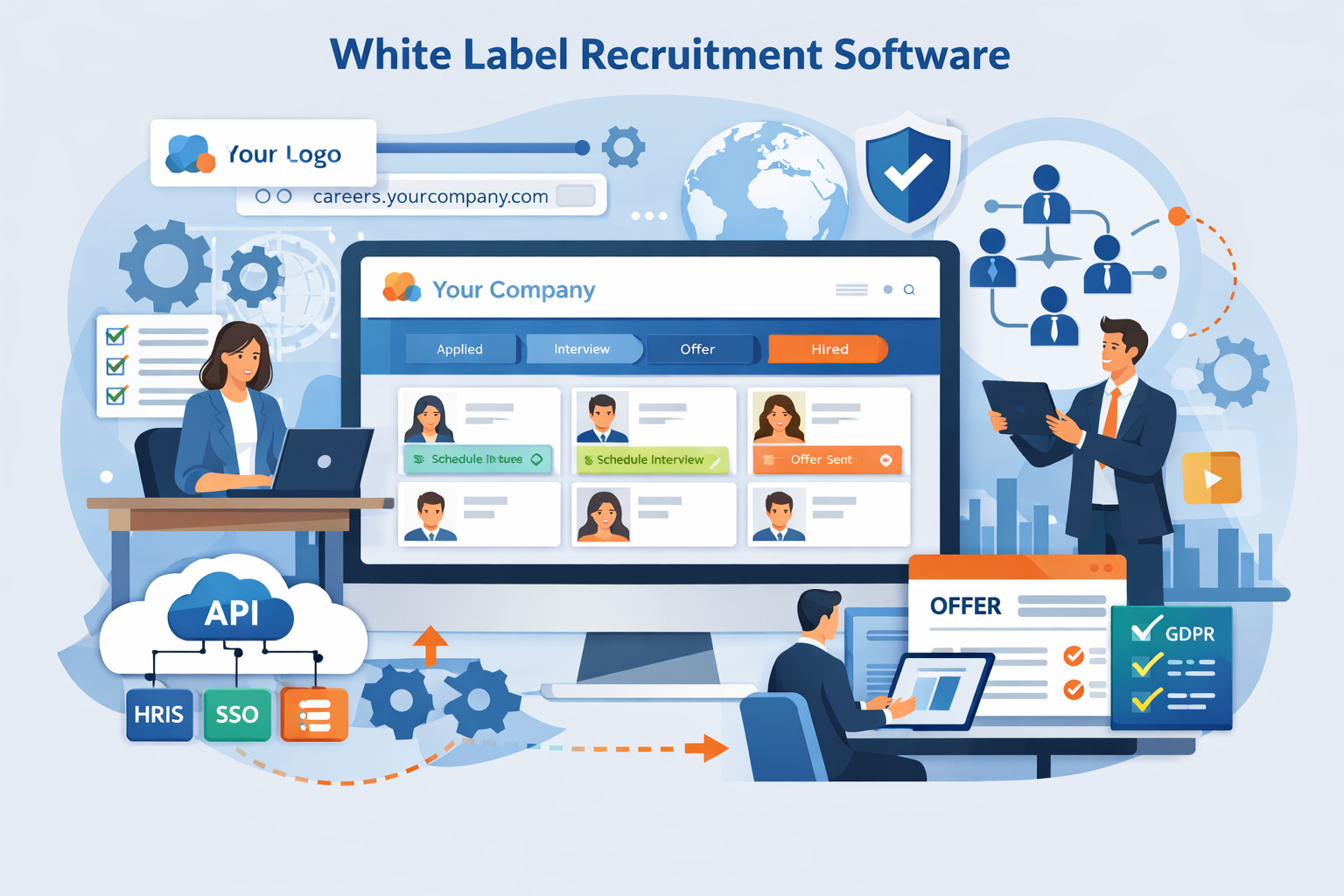
White label recruitment software is a ready-built recruitment platform developed by a technology provider but offered to enterprises under the enterprise’s own brand identity. This means the enterprise can launch the software as if it were their internal recruitment system, including their name, logo, domain, and UI theme.
For enterprises, white labeling is not just a branding decision. It is a strategic approach to:
-
Standardize hiring across multiple teams
-
Control candidate experience
-
Integrate hiring data with enterprise systems
-
Maintain compliance across geographies
-
Scale recruitment operations without constant re-platforming
Unlike traditional recruitment tools where the vendor brand stays visible and customization is limited, white label solutions allow enterprises to create a unified, company-owned hiring ecosystem.
What Makes White Label Recruitment Software Different from Traditional Hiring Platforms?
Traditional hiring platforms usually work like this: you subscribe, configure a few settings, and use the platform as designed. You may be able to customize some workflows or templates, but the core experience remains vendor-controlled.
White label recruitment software works differently. It is designed for enterprises that want:
-
Full control over branding and presentation
-
Advanced workflow configuration
-
Modular feature selection
-
Custom integrations and data ownership
-
Role-based controls aligned with enterprise hierarchy
This is especially important when recruitment is managed across multiple internal divisions or when a company wants to run hiring as a structured, governed process.
How White Label Applicant Tracking Software Fits into the Hiring Ecosystem
White label applicant tracking software is often the backbone of the recruitment system. It is the engine that tracks candidates from application to onboarding handoff.
In enterprise environments, applicant tracking is not just about storing resumes. It involves:
-
Managing high-volume candidate pipelines
-
Assigning candidates to recruiters and departments
-
Automating status updates and communications
-
Capturing evaluation and interview feedback
-
Generating audit-ready hiring records
-
Enforcing approvals and compliance checkpoints
A white label applicant tracking software system is built to operate under your company’s identity and policies, while still delivering the automation and intelligence expected from modern ATS platforms.
How White Label Recruitment Software Works for Enterprises Step by Step
Enterprises typically evaluate white label recruitment software when they want a scalable system without building one from scratch. Here is how it usually works in a real enterprise setup.
Step 1: Platform Selection and Requirements Mapping
The enterprise begins by identifying its hiring requirements such as:
-
Number of recruiters and hiring managers
-
Hiring volume per month or quarter
-
Number of job locations and departments
-
Compliance rules (GDPR, EEOC, local labor laws)
-
Reporting requirements and KPI tracking
-
Integrations with HRIS, SSO, payroll, and internal tools
A white label provider then maps these requirements to modules and customization options.
Step 2: Branding and Domain Configuration
Once the system is selected, branding is applied to make it enterprise-owned:
-
Logo and color palette
-
Custom domain setup (example: careers.company.com)
-
Candidate portal UI branding
-
Recruiter dashboard styling
-
Email templates and communication tone
This ensures candidates experience the hiring journey as a direct extension of the enterprise brand.
Step 3: Workflow Setup and Hiring Pipeline Customization
Enterprises rarely use the same workflow for every role. White label recruitment software allows configuring pipelines such as:
-
Corporate hiring workflow
-
Technical hiring workflow
-
Sales hiring workflow
-
Leadership hiring workflow
-
Campus recruitment workflow
-
Contract staffing workflow
Stages can be customized, for example:
-
Applied
-
Recruiter review
-
Screening call
-
Technical assessment
-
Panel interview
-
Final approval
-
Offer issued
-
Offer accepted
-
Background verification
-
Handoff to onboarding
Each stage can include required actions, approvals, and documentation.
Step 4: Role-Based Access and Permissions
Enterprise hiring requires strict role control. The platform typically defines roles such as:
Permissions are configured so each role can only access what is necessary. This protects data and reduces risk.
Step 5: Integration with Enterprise Systems
To work at scale, white label recruitment software must integrate with systems such as:
-
HRIS (Workday, SAP SuccessFactors, Oracle HCM)
-
SSO (Okta, Azure AD, Google Workspace)
-
Email and calendar (Microsoft 365, Google Calendar)
-
Background verification providers
-
Video interview platforms
-
Assessment tools
-
Payroll and onboarding systems
This prevents recruitment from becoming an isolated silo and ensures consistent employee data flow.
Step 6: Automation and Smart Candidate Communication
Modern enterprise hiring depends on speed. White label applicant tracking software supports automation like:
-
Auto-acknowledgment emails
-
Candidate status update triggers
-
Interview scheduling reminders
-
Offer letter generation
-
Rejection templates based on stage
-
Candidate follow-up sequences
Automation reduces manual workload and creates a consistent candidate experience.
Step 7: Analytics, Reporting, and Compliance Auditing
Enterprises must track recruitment performance and compliance. The system generates reports such as:
-
Time-to-fill by department
-
Source effectiveness
-
Recruiter performance metrics
-
Pipeline conversion rates
-
Offer acceptance rates
-
Diversity and inclusion reporting (where applicable)
-
Hiring manager turnaround time
-
Audit logs for decision-making history
This data supports strategic workforce planning and legal defensibility.
Key Modules Inside White Label Recruitment Software for Enterprises
A strong enterprise-grade platform is usually modular. Below are the core modules enterprises should expect.
Branded Career Portal Module
This is the public-facing part of the system where candidates:
-
Browse job openings
-
Filter roles by location, department, and experience
-
Apply with resume or profile
-
Track application status (if enabled)
Enterprises benefit because the portal reinforces employer branding and builds trust.
Applicant Tracking and Pipeline Management Module
This is the main module of white label applicant tracking software. It includes:
-
Candidate profiles and resume parsing
-
Stage movement tracking
-
Interview scheduling and feedback capture
-
Duplicate detection and talent pool management
-
Candidate tagging and segmentation
Enterprises need this module to maintain control over volume and complexity.
Job Posting and Multi-Channel Distribution Module
Enterprise hiring requires broad visibility. The system can distribute jobs to:
The platform should track source performance and ROI.
Recruitment CRM and Talent Pool Module
Enterprises cannot rely only on active applicants. A recruitment CRM helps build and reuse talent pools for:
This reduces future hiring costs and improves time-to-hire.
Interview Management and Collaboration Module
Enterprise hiring involves multiple stakeholders. The system must support:
-
Interview panel scheduling
-
Structured scorecards
-
Notes and feedback templates
-
Decision approval workflows
-
Candidate comparison views
This ensures hiring decisions are consistent and traceable.
Offer Management and Approval Module
Offer creation in enterprises often requires approvals. White label recruitment software supports:
This reduces errors and speeds up closing.
Compliance, Audit, and Security Module
This is a non-negotiable module for enterprises. It includes:
A platform without these capabilities is not enterprise-ready.
Why Enterprises Choose White Label Recruitment Software Over Building From Scratch
Enterprises typically have two options: build a custom recruitment platform internally or deploy a white label system.
White label recruitment software is preferred because it provides a middle path:
-
Faster deployment than building from scratch
-
Lower cost than full custom development
-
Customization and branding that standard SaaS platforms cannot match
-
Proven workflows and stability
-
Easier scaling and upgrades
For most enterprises, the goal is not to reinvent recruitment technology. The goal is to control it while scaling it.
Enterprise Benefits of White Label Applicant Tracking Software
White label applicant tracking software offers enterprise-specific benefits beyond standard ATS tools.
Better Candidate Trust Through Consistent Branding
Candidates are more likely to trust and complete applications when:
This reduces drop-offs and improves applicant completion rates.
Standardization Across Business Units
Enterprises often struggle with fragmented hiring practices. A white label platform can standardize:
Standardization improves quality and reduces risk.
Full Ownership of Recruitment Data and Reporting
Enterprises generate valuable hiring data. With white label recruitment software, they gain:
-
Better data control
-
Custom reporting dashboards
-
Integration-ready data pipelines
-
Reduced dependence on vendor analytics limitations
This supports long-term workforce planning.
Reduced Hiring Bottlenecks Through Automation
Enterprise hiring can slow down due to manual steps. Automation reduces delays in:
-
Candidate screening
-
Scheduling
-
Follow-ups
-
Hiring manager reminders
-
Approval routing
This improves time-to-hire without increasing recruiter workload.
Scalability for High-Volume and Global Hiring
Enterprises hiring across countries need:
White label applicant tracking software is built to support these enterprise realities.
Must-Have Enterprise Features in White Label Recruitment Software
Not all white label platforms are enterprise-grade. Enterprises should validate the following features.
Advanced Workflow Builder with Conditional Logic
Enterprise hiring workflows are not linear. The system should support:
-
Conditional stages based on role type
-
Auto-routing candidates to specific recruiters
-
Auto-rejection rules for mandatory criteria
-
Parallel interview stages
This reduces confusion and ensures process consistency.
Enterprise-Level Security and Authentication
Security is critical because recruitment data includes sensitive personal information. The platform should support:
-
Single sign-on (SSO)
-
Two-factor authentication (2FA)
-
Encryption at rest and in transit
-
IP restrictions (optional)
-
Admin-level audit logs
These controls are essential for enterprise compliance.
Custom Integrations and API Access
Enterprises need integration flexibility. The platform should offer:
-
REST API access
-
Webhooks for event-based automation
-
Prebuilt connectors for HRIS and SSO
-
Data export and BI tool compatibility
This ensures the recruitment system fits into the broader enterprise tech ecosystem.
Multi-Brand and Multi-Entity Support
Some enterprises operate multiple brands or subsidiaries. White label recruitment software should support:
-
Multiple career portals under one admin
-
Separate pipelines and reporting
-
Brand-specific templates and workflows
-
Shared talent pools if needed
This is crucial for enterprise groups.
Internal Mobility and Employee Referral Features
Enterprise hiring is not only external. The system should support:
-
Internal job postings
-
Employee referrals with tracking
-
Referral rewards management (optional)
-
Internal candidate tagging
This improves retention and reduces external recruitment costs.
How White Label Recruitment Software Supports Enterprise Hiring Teams Day to Day
A major value of white label recruitment software is operational efficiency. Here is how it supports each team.
For Recruiters: Better Pipeline Control and Reduced Manual Work
Recruiters benefit from:
-
Resume parsing
-
Automated candidate communication
-
Centralized candidate profiles
-
Bulk actions for high-volume roles
-
Structured interview scheduling
This allows recruiters to focus on quality hiring rather than administrative tasks.
For Hiring Managers: Faster Decisions and Better Collaboration
Hiring managers get:
-
Clear candidate shortlists
-
Structured scorecards
-
Interview feedback history
-
Decision workflows with approvals
-
Reduced email-based coordination
This improves hiring speed and reduces miscommunication.
For HR Leaders: Visibility and Strategic Reporting
HR leadership benefits from:
-
Workforce planning insights
-
Hiring funnel performance dashboards
-
Department-level hiring efficiency metrics
-
Compliance-ready records
-
Cost-per-hire tracking by source
This turns recruitment into a measurable, optimizable function.
For Compliance Teams: Reduced Risk and Better Documentation
Compliance teams benefit from:
This is essential for enterprise governance.
Common Enterprise Use Cases for White Label Recruitment Software
White label solutions are used across industries, but the most common enterprise use cases include:
Large-Scale Corporate Hiring Across Multiple Locations
Enterprises hiring across regions can standardize hiring while still allowing local flexibility.
High-Volume Frontline and Operational Hiring
Retail, logistics, healthcare, and hospitality enterprises often need:
White label applicant tracking software supports this volume efficiently.
Specialized Hiring for Technical and Leadership Roles
Enterprises hiring for technical roles require:
White label recruitment software supports these complex workflows.
Enterprise Hiring Through Multiple Recruitment Agencies
Some enterprises work with agencies for niche roles. A white label platform can:
-
Give agencies limited access
-
Track submissions
-
Prevent duplicate candidates
-
Maintain full enterprise control
This prevents chaos and improves transparency.
Implementation Challenges and How Enterprises Can Avoid Them
Even the best platform can fail if implementation is weak. Enterprises should plan for these challenges.
Challenge 1: Poor Workflow Design
Many enterprises copy old workflows without optimization. This leads to:
-
Too many stages
-
Unnecessary approvals
-
Slow candidate movement
Solution: Redesign workflows based on speed, accountability, and measurable KPIs.
Challenge 2: Low Adoption by Hiring Managers
If hiring managers do not use the system properly, recruitment slows down.
Solution: Provide training, simplify manager views, and use reminders and dashboards.
Challenge 3: Integration Delays
Enterprise integrations often take longer than expected.
Solution: Choose a white label provider with proven HRIS and SSO integration experience and a strong API layer.
Challenge 4: Data Migration Complexity
Migrating candidate data from old ATS systems can be difficult.
Solution: Migrate only essential records first, then import historical data in phases.
How to Choose the Right White Label Recruitment Software Provider for Enterprise Needs
Enterprises should evaluate providers based on capability, not just pricing.
Key evaluation criteria include:
-
Enterprise-grade security and compliance readiness
-
Workflow customization depth
-
ATS scalability for high-volume hiring
-
Integration capabilities and API documentation
-
Support and onboarding quality
-
Long-term roadmap and upgrade policies
-
Ability to support multi-brand enterprises
-
Reporting and analytics maturity
A strong provider should offer a structured onboarding plan and clear documentation.
Conclusion
White label recruitment software gives enterprises the ability to run hiring at scale with full branding control, workflow flexibility, data ownership, and integration power. Instead of being limited by generic recruitment tools, enterprises can build a standardized, secure, and scalable hiring ecosystem aligned with their internal structure.
When paired with white label applicant tracking software, enterprises gain a complete candidate management engine that supports everything from sourcing and screening to interview collaboration, offers, and compliance reporting. For modern enterprises, this is not just a technology upgrade, it is a strategic investment in workforce growth and operational efficiency.
Frequently Asked Questions
What is white label recruitment software and who should use it?
White label recruitment software is a ready-made recruitment platform that enterprises can launch under their own branding, domain, and workflows. It is ideal for large companies that need standardized hiring processes, advanced permissions, custom integrations, and enterprise-grade reporting.
What is the difference between white label recruitment software and a standard ATS?
A standard ATS typically has limited customization and is branded by the vendor. White label recruitment software can be branded as the enterprise’s own system and usually offers deeper workflow customization, stronger integration capabilities, and enterprise-level governance controls.
How does white label applicant tracking software help enterprise hiring teams?
White label applicant tracking software helps enterprises manage candidate pipelines, automate hiring workflows, coordinate interviews, track decisions, and generate compliance-ready records. It improves hiring speed and consistency across departments and locations.
Can white label recruitment software integrate with HRIS and SSO systems?
Yes. Enterprise-grade platforms are built to integrate with HRIS tools like Workday or SAP SuccessFactors and support SSO systems like Okta or Azure AD. Integration readiness is one of the most important selection criteria for enterprises.
Is white label recruitment software secure enough for enterprises?
It can be, but only if the provider supports enterprise security requirements such as encryption, audit logs, role-based access, data retention policies, and authentication controls like SSO and 2FA. Enterprises should validate these capabilities before deployment.
How long does it take to implement white label recruitment software in an enterprise?
Implementation time depends on workflow complexity, integration requirements, and data migration scope. A basic enterprise rollout can take a few weeks, while a multi-entity or global enterprise setup can take several months.
Can enterprises run multiple brands or subsidiaries under one system?
Yes. Many enterprise-focused white label recruitment software platforms support multi-brand and multi-entity setups, allowing separate career portals, workflows, and reporting while maintaining centralized governance.
Does white label recruitment software support high-volume hiring?
Yes. High-volume hiring is one of the most common enterprise use cases. The platform should support bulk actions, automation, fast screening workflows, and scalable infrastructure to handle large candidate pipelines.
What should enterprises check before selecting a white label applicant tracking software provider?
Enterprises should check workflow flexibility, security standards, integration support, reporting depth, scalability, compliance tools, and the provider’s experience with enterprise deployments. A provider’s onboarding and long-term support capabilities also matter significantly.




 English
 Arabic
 French
 Spanish
 Portuguese
 Deutsch
 Dutch
Dutch
 Italiano
 Russian
 Romaian
 Portuguese (Brazil)
 Greek
Greek
