


How Can the Raspberry Pi 5 2GB Integrate with Sensors for IoT Devices
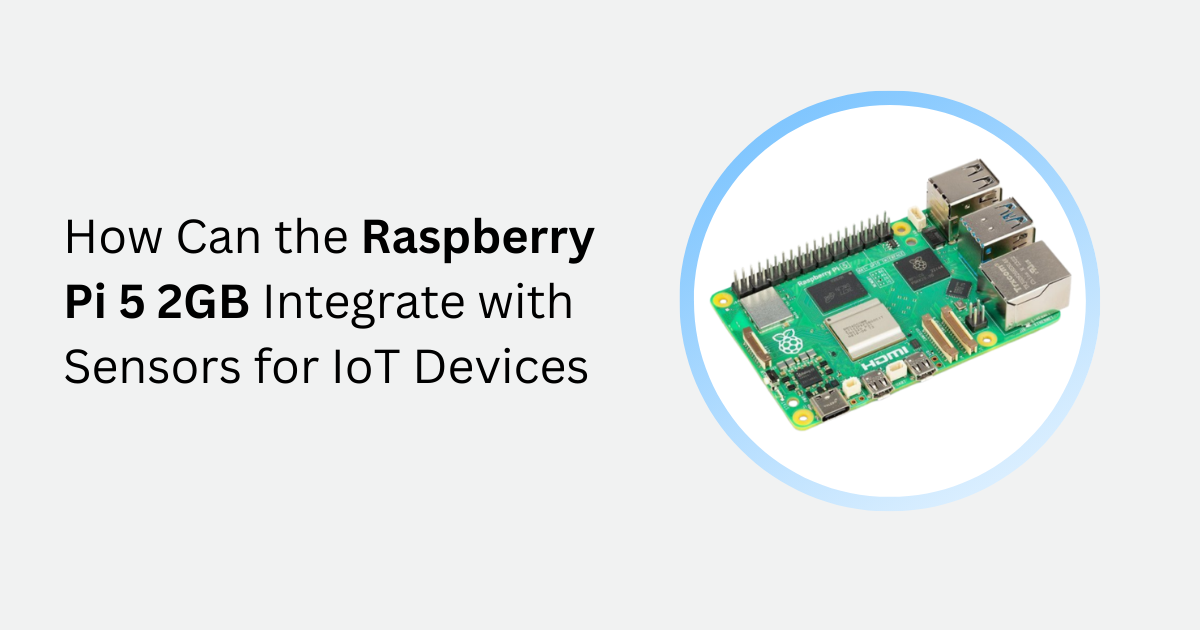
IoT systems depend on accurate data from physical sensors. These sensors measure temperature, motion, pressure, light, and many other variables. The Raspberry Pi 5 2gb plays a key role in connecting these sensors to software systems. It works as a compact computing platform that collects, processes, and sends sensor data to local or remote systems.
The Raspberry Pi 5 improves performance, interface speed, and stability compared to earlier models. These improvements make it suitable for modern IoT workloads that require reliable data handling and continuous operation.
This article explains how the Raspberry Pi 5 2gb integrates with sensors from a technical viewpoint. It focuses on hardware interfaces, software design, data handling, and real-world usage.
Understanding the Raspberry Pi 5 2GB in IoT Systems
The Raspberry Pi 5 2gb is a single-board computer with enough memory and processing power for edge-level IoT tasks. It runs a full Linux operating system, which allows developers to use standard tools and libraries.
Key technical features include:
-
Quad-core 64-bit CPU
-
2 GB LPDDR4X RAM
-
40-pin GPIO header
-
USB 2.0 and USB 3.0 ports
-
Ethernet and wireless networking
In IoT environments, this board often acts as a sensor gateway. It sits between physical sensors and higher-level systems such as databases, dashboards, or cloud platforms.
Role of Sensors in IoT Devices
Sensors convert physical conditions into electrical signals. IoT systems rely on these signals to make decisions or provide insights.
Common sensor categories include:
-
Environmental sensors
-
Motion and proximity sensors
-
Pressure and force sensors
-
Electrical and current sensors
-
Position and rotation sensors
The Raspberry Pi 5 receives sensor signals, interprets them, and converts them into structured digital data.
Hardware Interfaces Used for Sensor Integration
1. GPIO Digital Pins
GPIO digital pins provide a simple interface for connecting sensors, allowing devices to read or write digital signals. Common uses include motion detection, button states, and magnetic door sensors, with software controlling each pin’s input or output mode.
2. I²C Communication Interface
The I²C communication interface uses two shared lines, enabling multiple sensors to connect on the same bus. It offers reduced wiring, address-based device selection, and low power usage, making it ideal for low-data-rate environmental sensors.
3. SPI Communication Interface
The SPI communication interface enables faster data transfer than I²C by using separate lines for clock, data, and chip selection. It suits high-resolution sensors, fast-sampling devices, and displays, with the Raspberry Pi 5 2GB supporting multiple SPI devices via software-controlled chip select.
4. Using External Analog-to-Digital Converters
The Raspberry Pi 5 cannot read analog signals directly, so external analog-to-digital converters (ADCs) are used. ADCs enable connection of gas sensors, light-dependent resistors, and variable voltage outputs by converting analog voltages into digital values readable by the Pi.
Sensor Power and Electrical Considerations
Most sensors operate at low voltage, and the Raspberry Pi 5 with 2GB RAM provides both 3.3 V and 5 V power rails, ensuring compatibility with a wide range of sensor types while supporting safe and stable operation.
Key points include:
-
GPIO pins operate at 3.3 V logic
-
Overvoltage damages GPIO pins
-
Current limits must be respected
Level shifters may be required when using 5 V sensors.
Operating System and Driver Support
The Raspberry Pi 5 runs Linux-based operating systems, providing a flexible environment that simplifies sensor integration through extensive driver support, libraries, and community resources for efficient development of IoT applications.
Advantages include:
-
Built-in kernel drivers
-
Stable hardware abstraction
-
Long-term maintenance
Most sensor libraries interact with kernel interfaces rather than raw hardware.
Programming Sensors Using Python
Python is widely used for IoT development on Raspberry Pi boards, offering simplicity, extensive libraries, and strong community support, which makes programming sensors, reading data, and controlling devices straightforward and efficient.
Reasons include:
-
Clear syntax
-
Extensive hardware libraries
-
Fast development cycles
Python libraries handle communication protocols and error handling. This reduces development time and improves reliability.
Handling Sensor Data in Real Time
Handling sensor data in real time is essential for responsive IoT systems, as sensor readings often arrive continuously and must be processed immediately. The Raspberry Pi 5 with 2GB of RAM is capable of performing real-time data processing, enabling tasks such as noise filtering, averaging values, and comparing readings against predefined thresholds. By processing data at the edge, the system reduces network traffic, minimizes latency, and allows for faster responses to critical events, improving both efficiency and overall reliability of IoT deployments.
Data Storage Strategies
Data storage is an important aspect of IoT systems, as sensor data is often collected locally before being transmitted to external servers or cloud platforms. Storage options vary depending on the system’s requirements: flat files are suitable for small datasets, embedded databases provide structured storage for more complex data, and circular buffers help manage memory efficiently in devices with limited resources. By time-stamping stored data, IoT systems can support historical analysis and trend detection, enabling better decision-making and long-term monitoring of environmental or operational conditions.
Communication with External Systems
Communication with external systems is a key function of IoT devices, enabling processed data to be shared with other devices, cloud platforms, or monitoring applications. The Raspberry Pi 5 supports multiple communication methods, including Ethernet, wireless data transmission, and secure, encrypted connections. Protocols such as MQTT and HTTPS facilitate efficient and reliable data transfer, ensuring that information from IoT nodes can be transmitted safely and promptly to external systems for analysis, storage, or automated responses.
Example: Smart Environmental Monitoring Node
A practical example of a smart environmental monitoring IoT node includes a temperature sensor, humidity sensor, and light sensor. Using a Raspberry Pi 5 with 2GB of RAM, the system collects sensor readings every minute, filters out noise, and checks whether values exceed predefined thresholds. When thresholds are crossed, the node sends alerts to notify users of potential issues. This type of system is well-suited for applications such as agricultural monitoring, indoor air quality control, and server room environment management, providing real-time data and actionable insights to maintain optimal conditions.
Edge Computing Benefits
Edge computing involves processing data close to its source rather than sending it to centralized cloud servers. This approach offers several benefits, including reduced latency, lower bandwidth usage, and increased system reliability. By handling data locally, IoT systems can respond more quickly to events and operate efficiently even with limited network connectivity. Statistics indicate that over 60% of IoT data is now processed at the edge, a trend that continues to grow as sensor density and the volume of generated data increase, highlighting the importance of edge computing in modern IoT deployments.
Scaling IoT Sensor Networks
Scaling IoT sensor networks is an important consideration as small projects often expand into large, complex deployments. Effective scaling requires standardized sensor interfaces, automated device configuration, and central monitoring tools to manage and coordinate numerous devices efficiently. The Raspberry Pi 5 supports fleet management software, making it well-suited for handling large networks by simplifying device oversight, streamlining configuration, and ensuring reliable operation across an extensive IoT deployment.
Power Management in IoT Deployments
Power management is a crucial aspect of IoT deployments, as many systems rely on limited or battery-powered energy sources. Effective techniques for conserving power include scheduled sensor sampling, CPU frequency scaling, and shutting down peripheral components during idle periods. By optimizing energy consumption, these strategies not only extend the operational life of IoT devices but also enhance overall system reliability, ensuring that devices can function continuously without frequent maintenance or battery replacements.
Security in Sensor-Based IoT Systems
Security is a critical concern in sensor-based IoT systems, as these environments are often vulnerable to unauthorized access and data breaches. Best practices for securing IoT systems include encrypted data transmission, device authentication, and controlled network access, all of which help protect sensitive information and prevent malicious intrusions. Industry studies indicate that nearly 45% of IoT security breaches involve unsecured sensor nodes, highlighting the importance of proper security measures. Implementing secure configurations for sensors and devices significantly reduces this risk and ensures the integrity and safety of the overall IoT system.
Reliability and Maintenance
Reliability and maintenance are critical aspects of IoT systems, as these systems are often required to operate continuously without interruption. To ensure consistent performance, maintenance strategies such as automatic software updates, watchdog timers, and sensor fault detection are commonly employed. These approaches help prevent system failures, quickly identify issues, and maintain overall system stability. The Raspberry Pi 5 with 2GB of RAM supports both hardware and software monitoring tools, enabling developers to implement these maintenance strategies effectively and ensure reliable operation of IoT applications.
Industry Usage and Growth Statistics
IoT adoption continues to rise across industries.
Key statistics:
-
Over 20 billion IoT devices operate globally
-
Sensor-based systems account for more than 70% of IoT deployments
-
Manufacturing and agriculture lead in sensor adoption
These numbers show the importance of flexible computing platforms like the Raspberry Pi 5.
Conclusion
The Raspberry Pi 5 2gb integrates effectively with sensors for IoT devices through its versatile hardware interfaces, strong software support, and reliable processing capability. It reads sensor data, processes it locally, and communicates results efficiently. The Raspberry Pi 5 suits both small prototypes and large-scale deployments. As IoT systems continue to expand, sensor integration using this platform remains a practical and technically sound choice.

 English
 Arabic
 French
 Spanish
 Portuguese
 Deutsch
 Turkish
 Dutch
Dutch
 Russian
 Romaian
 Portuguese (Brazil)
 Greek
Greek
