


How Virtual Instrument Cluster Systems Support Software Updates
Evolution of the Automotive Instrument Cluster
The automotive instrument cluster has long served as the primary interface between the vehicle and the driver, displaying critical information such as speed, fuel levels, and warning indicators. In recent years, this component has undergone a major transformation driven by advances in electronics, software, and user experience design. What was once a purely mechanical assembly is now a sophisticated digital platform that enhances safety, personalization, and connectivity. As vehicles become more intelligent and software-defined, the instrument cluster is evolving into a central element of the in-vehicle experience.
Shift from Analog to Digital Displays
Traditionally, the analog instrument cluster dominated passenger and commercial vehicles, valued for its simplicity, durability, and low cost. Mechanical gauges and fixed backlit displays provided essential data with minimal distraction. Even today, analog clusters remain relevant in entry-level vehicles and certain utility segments where robustness and affordability are priorities. However, consumer expectations are changing rapidly as drivers become accustomed to digital interfaces in their everyday devices.
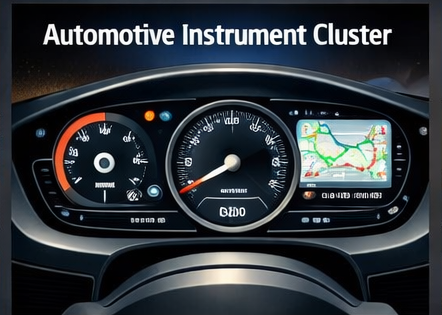
This shift has accelerated the adoption of the digital instrument cluster, which replaces physical dials with LCD or OLED screens. Digital clusters offer greater flexibility, allowing automakers to reconfigure layouts, add navigation prompts, and integrate advanced driver assistance system (ADAS) alerts. Customization has become a key differentiator, enabling drivers to choose display themes, prioritize information, and even adapt visuals based on driving modes. As display costs decline and processing power increases, digital solutions are moving beyond premium vehicles into mid-range segments.
Rise of the Virtual Instrument Cluster Experience
Building on digital displays, the virtual instrument cluster represents the next stage of innovation. In a virtual setup, all instrumentation is software-driven, often powered by high-performance system-on-chip (SoC) platforms. This allows seamless integration with infotainment systems, head-up displays, and cloud-based services. Over-the-air updates can add new features or improve visual performance without requiring hardware changes, aligning well with the broader trend of software-defined vehicles.
Virtual clusters also play a critical role in electric and hybrid vehicles, where traditional gauges are less relevant. Instead of tachometers, drivers may see energy flow diagrams, battery health indicators, and real-time efficiency analytics. This redefinition of what an instrument cluster shows reflects how powertrain electrification is reshaping vehicle architecture and driver information needs.
The rapid technological evolution of instrument clusters is mirrored by strong market growth. In simple terms, the market is expanding steadily as automakers invest in advanced displays, connectivity, and user-centric design. Recent industry analysis indicates that the global automotive instrument cluster market is on a solid upward trajectory, driven by rising vehicle production, growing demand for premium interiors, and the increasing penetration of digital cockpits. According to Grand View Research, the market is expected to reach approximately USD 13.42 billion by 2030, growing at a robust pace through the second half of the decade. This growth highlights the strategic importance of instrument clusters within the broader automotive electronics ecosystem.
Integration with Connectivity and Future Trends
Looking ahead, the instrument cluster will continue to converge with infotainment, ADAS, and vehicle connectivity platforms. As vehicles become more autonomous, clusters will shift from displaying driving metrics to conveying system status, situational awareness, and handover alerts. Augmented reality elements, enhanced graphics, and AI-driven personalization are also emerging trends that will redefine how information is presented.
In parallel, automakers are balancing innovation with safety and regulatory requirements. Clear readability, minimal driver distraction, and functional redundancy remain essential, whether in a digital instrument cluster or a modernized analog instrument cluster. Ultimately, the future of the automotive instrument cluster lies in delivering the right information at the right time, combining technological sophistication with intuitive design to support safer and more engaging driving experiences.

 English
 Arabic
 French
 Spanish
 Portuguese
 Deutsch
 Turkish
 Dutch
Dutch
 Italiano
 Romaian
 Portuguese (Brazil)
 Greek
Greek
