


AR Navigation Technology and the Future of Location Intelligence
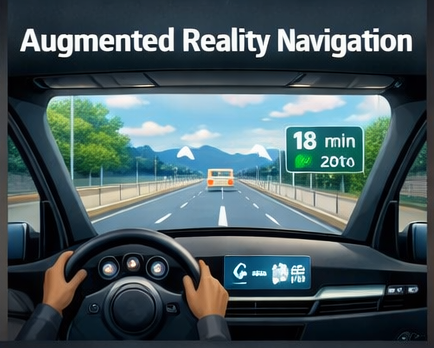
Augmented Reality Navigation: Transforming the Way People Move Through the World
Augmented reality navigation is rapidly redefining how individuals and organizations interact with physical spaces. By overlaying digital directions, symbols, and contextual information onto the real world, this technology removes much of the friction associated with traditional maps and GPS interfaces. As smartphones, smart glasses, and vehicle head-up displays become more advanced, AR navigation technology is moving from novelty to necessity across consumer, enterprise, and mobility use cases.
From Static Maps to Articulated Guidance
One of the most notable trends is the shift from static visual overlays to articulated augmented reality navigation, where directions are presented as animated arrows, dynamic paths, or step-by-step cues that appear anchored to real-world landmarks. This articulated approach significantly improves spatial understanding, especially in dense urban environments, large campuses, airports, and shopping complexes. Users no longer need to interpret abstract symbols on a flat map; instead, navigation instructions appear exactly where decisions need to be made.
This evolution is powered by advances in computer vision, simultaneous localization and mapping (SLAM), and AI-driven object recognition. Together, these capabilities allow an augmented reality navigation system to understand surroundings in real time, ensuring that digital directions remain accurate even when GPS signals are weak or unavailable, such as indoors or underground.
Expanding Use of AR Navigation Apps
Consumer adoption is being driven largely by the growing ecosystem of AR navigation apps. Major mapping platforms and startups alike are integrating AR modes that use smartphone cameras to guide pedestrians with real-world overlays. These apps are particularly popular among travelers and urban commuters, offering intuitive guidance through unfamiliar areas.
Beyond consumer use, enterprises are deploying customized AR navigation apps for internal operations. Warehouses use AR-based wayfinding to guide workers to exact shelf locations, while hospitals rely on AR navigation to help staff and visitors find departments quickly. In smart cities, AR navigation technology is also being explored to improve accessibility for visually or cognitively impaired users by combining audio cues with visual overlays.
The commercial momentum behind augmented reality navigation is substantial. The global augmented reality navigation market size is projected to reach USD 11.69 billion by 2030, growing at a CAGR of 39.1% from 2025 to 2030, according to Grand View Research. This growth reflects rising investments from technology providers, automotive OEMs, and urban infrastructure developers who view AR navigation as a core component of future digital ecosystems.
This rapid expansion is also supported by improvements in hardware. Lighter smart glasses, more powerful mobile processors, and vehicle-integrated AR displays are enabling always-on navigation experiences without draining batteries or overwhelming users. As 5G and edge computing mature, latency-sensitive AR navigation systems will become even more responsive and precise.
Integration Across Industries
Automotive and mobility sectors are among the most active adopters. Modern vehicles increasingly feature windshield-based AR navigation technology that projects lane guidance, hazard warnings, and turn indicators directly into the driver’s line of sight. This reduces cognitive load and enhances safety compared to traditional dashboard navigation screens.
At the same time, tourism, retail, and real estate industries are using augmented reality navigation to enrich customer experiences. Museums guide visitors through exhibits, malls provide personalized routes to stores, and large office complexes use AR navigation systems to streamline visitor management. These applications demonstrate how AR navigation is evolving beyond simple directions into a broader spatial interaction platform.
As artificial intelligence, spatial computing, and wearable devices continue to converge, augmented reality navigation will become more contextual, predictive, and personalized. Rather than simply telling users where to go, future solutions will anticipate intent, adapt to real-time conditions, and seamlessly blend digital intelligence into the physical world. This shift positions augmented reality navigation as a foundational technology for smarter, more intuitive movement across both public and private spaces.

 English
 Arabic
 French
 Spanish
 Portuguese
 Deutsch
 Turkish
 Dutch
Dutch
 Italiano
 Romaian
 Portuguese (Brazil)
 Greek
Greek
