


Dehumidifier Market: Indoor Air Quality Trends and Growth Outlook
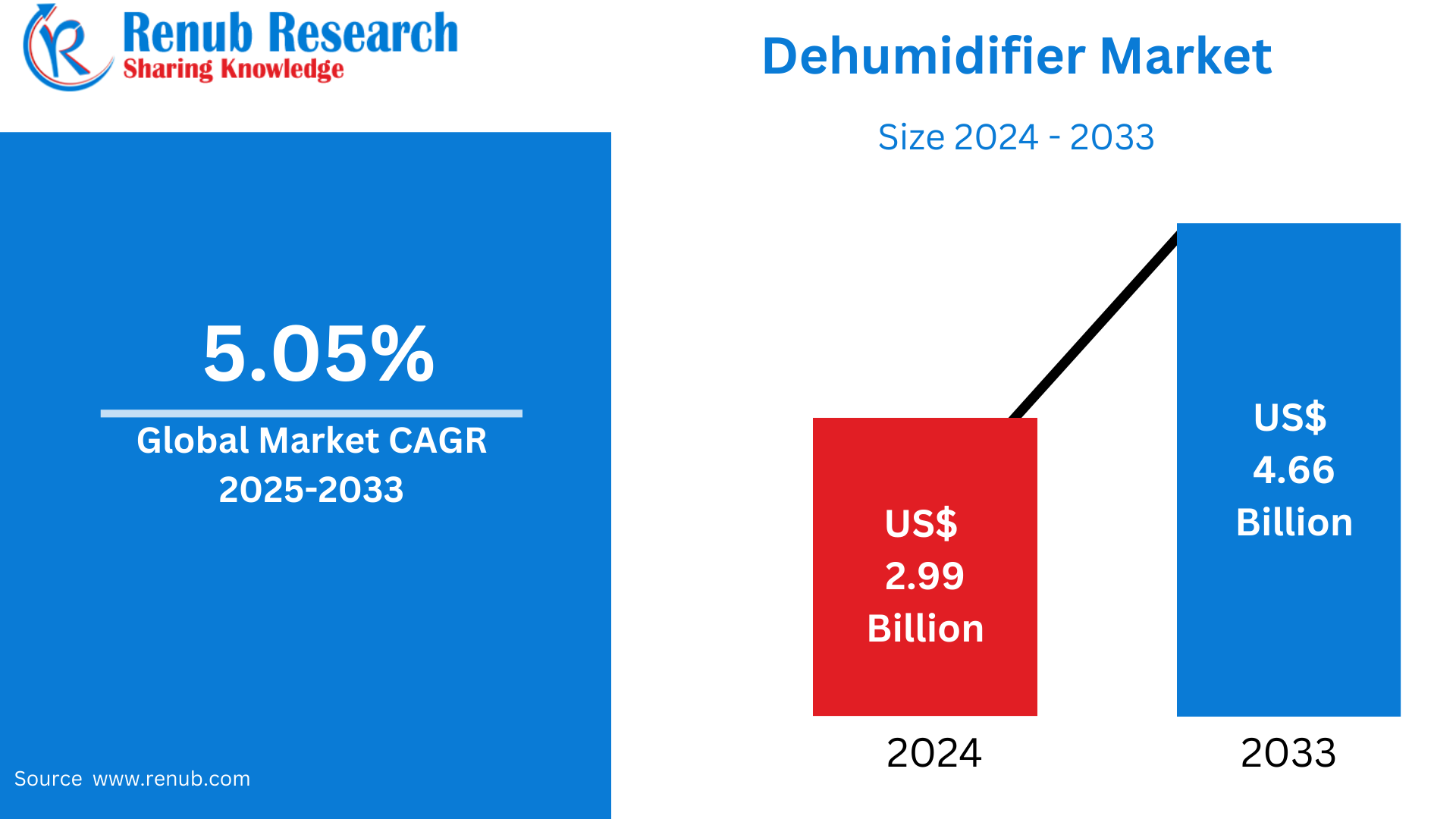
Dehumidifier Market Size and Forecast 2025–2033
According To Renub Research global dehumidifier market is poised for consistent growth as humidity-related challenges become more prominent across residential, commercial, and industrial environments. The market is projected to expand from US$ 2.99 billion in 2024 to US$ 4.66 billion by 2033, registering a compound annual growth rate of 5.05% from 2025 to 2033. Rising awareness of indoor air quality, increasing health concerns linked to excessive humidity, rapid urbanization, and the effects of global climate change are collectively driving demand for efficient moisture control solutions. Technological innovation and the integration of smart features are further reshaping the market landscape.
Dehumidifier Industry Overview
A dehumidifier is an electrical appliance designed to remove excess moisture from indoor air, helping maintain optimal humidity levels. By drawing moist air over cooled coils or absorbent materials, dehumidifiers condense water vapor and collect it in a storage tank or drain it away. This process reduces dampness, prevents mold growth, eliminates musty odors, and protects both human health and physical assets.
Dehumidifiers are widely used in homes, offices, hospitals, warehouses, manufacturing plants, and data centers. Excess humidity can damage building structures, corrode equipment, and create an unhealthy living environment. As a result, dehumidifiers play a crucial role in enhancing indoor comfort, preserving sensitive goods, and ensuring regulatory compliance in moisture-sensitive industries. Modern units increasingly incorporate smart sensors, automated controls, and energy-efficient technologies, making them more user-friendly and cost-effective.
Download Free Sample Report:https://www.renub.com/request-sample-page.php?gturl=global-dehumidifier-market-p.php
Key Growth Drivers in the Dehumidifier Market
Technological Advancements and Smart Features
Technological innovation is a major driver shaping the dehumidifier market. Manufacturers are developing advanced models with improved energy efficiency, digital humidity controls, and smart connectivity. Features such as Wi-Fi integration, mobile app monitoring, automatic defrost, and self-diagnosis systems allow users to manage indoor humidity remotely and more precisely.
Energy-efficient compressors and intelligent humidity sensors reduce power consumption while maintaining consistent performance. These advancements appeal to both residential users seeking convenience and commercial or industrial users focused on operational efficiency. As smart home adoption increases globally, demand for intelligent dehumidifiers is expected to rise steadily.
Rising Awareness of Indoor Air Quality and Health
Growing awareness of the link between humidity and health issues is significantly boosting dehumidifier adoption. High humidity levels encourage the growth of mold, mildew, and dust mites, which can trigger allergies, asthma, and respiratory illnesses. As consumers become more conscious of these risks, dehumidifiers are increasingly viewed as essential appliances rather than optional accessories.
This trend is particularly strong in urban environments, where airtight building designs and limited ventilation can trap moisture indoors. Healthcare facilities, schools, and offices are also investing in dehumidification systems to create healthier indoor environments and reduce the spread of airborne contaminants.
Expanding Applications Across End-Use Sectors
The scope of dehumidifier applications continues to expand across residential, commercial, and industrial sectors. In residential settings, dehumidifiers enhance comfort, protect furniture, and prevent structural damage. Commercial spaces such as retail stores, hotels, and hospitals rely on humidity control to maintain air quality and protect assets.
Industrial demand is growing rapidly in sectors such as pharmaceuticals, food processing, electronics manufacturing, and data centers, where precise humidity control is critical for product quality and equipment performance. As industries prioritize operational reliability and regulatory compliance, high-capacity and specialized dehumidifiers are gaining traction.
Challenges in the Dehumidifier Market
High Initial Cost of Advanced Systems
One of the key challenges facing the dehumidifier market is the high upfront cost associated with advanced and high-capacity units. Commercial and industrial-grade dehumidifiers often require significant capital investment, which can deter small businesses and cost-sensitive buyers. Even in the residential segment, smart and energy-efficient models may be perceived as expensive by budget-conscious consumers.
In developing regions, lower disposable income levels further limit adoption, despite the growing need for humidity control. This cost barrier can delay purchasing decisions and slow market penetration.
Energy Consumption Concerns
Energy consumption remains a critical concern, particularly for older or continuously operating dehumidifiers. Prolonged usage in high-humidity regions can result in increased electricity bills, discouraging consistent use. Environmental concerns related to carbon emissions also place pressure on manufacturers to develop more sustainable solutions.
While energy-efficient models are becoming more common, consumers increasingly expect appliances that balance performance with low power consumption. Failure to meet these expectations may hinder adoption, especially in regions with high energy costs or strict environmental regulations.
Dehumidifier Market by Product Type
Chemical Absorbent Dehumidifiers
Chemical absorbent, or desiccant, dehumidifiers use moisture-absorbing materials to remove humidity from the air. These units are particularly effective in low-temperature environments and are widely used in industrial applications, storage facilities, and laboratories. Their ability to perform consistently in challenging conditions makes them suitable for specialized uses.
Heat Pump Dehumidifiers
Heat pump dehumidifiers are the most commonly used type, especially in residential and commercial settings. They operate by cooling air to condense moisture and reheating it before release. These units offer a balance of efficiency, affordability, and performance, making them popular for everyday indoor humidity control.
Ventilating Dehumidifiers
Ventilating dehumidifiers combine air exchange with moisture removal, making them ideal for larger buildings and energy-efficient homes. By introducing fresh air while controlling humidity, these systems support overall indoor air quality and are often integrated into HVAC systems.
Dehumidifier Market by End Use
Residential Segment
The residential segment represents a significant share of the dehumidifier market. Homeowners increasingly invest in dehumidifiers to improve comfort, protect property, and address health concerns related to dampness. Compact, portable, and smart-enabled models are particularly popular in this segment.
Commercial Segment
Commercial applications include offices, retail spaces, hotels, hospitals, and educational institutions. These environments require consistent humidity control to ensure occupant comfort, protect furnishings, and comply with health standards. Demand in this segment is driven by urbanization and the expansion of commercial infrastructure.
Industrial Segment
Industrial users rely on high-capacity dehumidifiers for precise moisture management in manufacturing, storage, and processing environments. Industries such as pharmaceuticals, food and beverage, electronics, and data centers depend heavily on humidity control to maintain product integrity and operational efficiency.
Regional Dehumidifier Market Insights
United States Dehumidifier Market
The United States dehumidifier market is driven by rising humidity levels, climate variability, and strong awareness of indoor air quality. Demand spans residential, commercial, and industrial sectors, with increasing interest in smart and energy-efficient models. Regulatory changes related to energy efficiency standards may influence competitive dynamics and product positioning in the coming years.
Germany Dehumidifier Market
Germany’s dehumidifier market benefits from strong environmental awareness, strict building regulations, and a robust industrial base. Energy efficiency and sustainability are key purchasing criteria for German consumers and businesses. Industrial demand remains strong in manufacturing, logistics, and pharmaceutical sectors where controlled humidity is essential.
China Dehumidifier Market
China represents one of the fastest-growing dehumidifier markets globally, supported by urbanization, rising disposable incomes, and increasing awareness of indoor air quality. Domestic manufacturers leverage strong production capabilities to offer cost-effective and technologically advanced products, driving both domestic adoption and exports.
Saudi Arabia Dehumidifier Market
In Saudi Arabia, demand for dehumidifiers is growing in line with infrastructure development, industrial expansion, and climate conditions. Dehumidification systems are increasingly integrated into HVAC installations across commercial and industrial facilities. Regulatory standards and investments under national development programs are further supporting market growth.
Competitive Landscape and Key Players
The global dehumidifier market is moderately competitive, with manufacturers focusing on innovation, energy efficiency, and geographic expansion. Key players compete through product differentiation, smart technology integration, and strategic partnerships. Prominent companies include Haier Smart Home, LG Electronics, Whirlpool Corporation, Honeywell International, Munters AB, Electrolux, De’Longhi Group, Gree Electric Appliances, Mitsubishi Electric, and Midea Group.
Future Outlook of the Dehumidifier Market
The dehumidifier market is expected to maintain steady growth through 2033 as humidity management becomes increasingly important for health, comfort, and industrial efficiency. Advancements in smart technology, energy efficiency, and product design will continue to expand application areas. While challenges related to cost and energy consumption persist, rising awareness of indoor air quality and climate-related humidity issues will ensure sustained demand for dehumidification solutions across global markets.

 English
 Arabic
 French
 Spanish
 Portuguese
 Deutsch
 Turkish
 Dutch
Dutch
 Russian
 Romaian
 Portuguese (Brazil)
 Greek
Greek
