


Confocal Raman Microscopy System Market Growing at 7.4% CAGR Through 2034 Amid Increasing Adoption in Life Sciences and Pharma
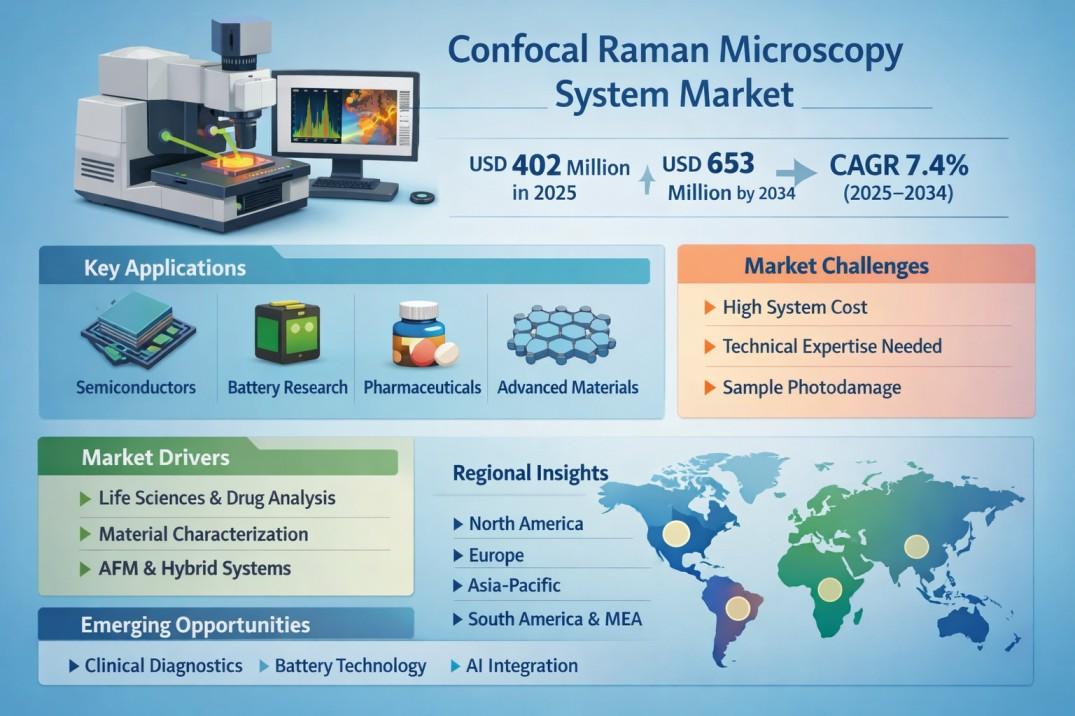
According to a new report from Intel Market Research, the global Confocal Raman Microscopy System market was valued at USD 402 million in 2025 and is projected to grow from USD 431 million in 2026 to reach USD 653 million by 2034, exhibiting a robust CAGR of 7.4% during the forecast period (2025–2034). This growth is driven by the accelerating adoption of advanced chemical imaging technologies across semiconductor manufacturing, battery materials research, pharmaceutical quality control, and life sciences, underscored by rising global R&D expenditure and the expanding integration of artificial intelligence into analytical instrumentation.
What is a Confocal Raman Microscopy System?
A Confocal Raman Microscopy System is a sophisticated analytical instrument that integrates lasers, microscopes, spectrometers, and automated motorized stages to analyze the chemical composition distribution of materials at micrometer or submicrometer scales. The technology works by isolating Raman signals at the focal point through a pinhole-limited optical path, enabling precise, spatially resolved material characterization without destructive sample preparation. Key components include multi-wavelength lasers operating at 532, 633, 785, and 1064 nm wavelengths, back-illuminated CCD or InGaAs detectors optimized for near-infrared applications, and motorized XYZ scanning stages that support both point measurements and line scanning functionalities.
The technology's adoption is accelerating across academic research and industrial quality control environments due to its unique capability to provide non-destructive, label-free chemical mapping. While fluorescence suppression and thermal stability remain ongoing technical challenges, continuous innovations in AI-assisted data analysis and hybrid systems combining atomic force microscopy (AFM) are expanding application frontiers-particularly in semiconductor stress analysis and pharmaceutical polymorph screening.
This report provides a deep insight into the global Confocal Raman Microscopy System market, covering all its essential aspects-from a macro overview of the market to micro details such as market size, competitive landscape, development trends, niche markets, key drivers and challenges, SWOT analysis, and value chain analysis.
The analysis helps the reader understand competition within the industry and strategies for enhancing profitability. Furthermore, it provides a framework for evaluating and assessing the position of a business organization. The report also focuses on the competitive landscape of the Global Confocal Raman Microscopy System Market, introducing market share, performance, product positioning, and operational insights of major players. This helps industry professionals identify key competitors and understand prevailing competition patterns.
In short, this report is a must-read for industry players, investors, researchers, consultants, business strategists, and all those planning to foray into the Confocal Raman Microscopy System market.
📥 Download Sample Report:
Confocal Raman Microscopy System Market - View in Detailed Research Report
Key Market Drivers
1. Expanding Applications in Life Sciences and Pharmaceuticals
The growth of the Confocal Raman Microscopy System Market is primarily driven by its indispensable role in advanced life sciences research. These systems enable non-destructive, label-free chemical imaging of live cells and tissues, providing critical insights into disease mechanisms and drug-cell interactions. The ability to analyze specific molecular components-such as proteins, lipids, and nucleic acids-without fluorescent tags has become a cornerstone capability in modern biomedical research, directly supporting the development of new therapeutics. In the pharmaceutical sector, these systems are equally vital for analyzing polymorph distribution and verifying drug product homogeneity during quality control, ensuring compliance with stringent regulatory standards.
2. Increasing Demand for Material Characterization in High-Growth Industries
In sectors such as semiconductors, 2D materials research, and polymer science, the demand for high-resolution chemical mapping has become a significant market driver. Confocal Raman microscopy provides unparalleled spatial resolution for analyzing stress distributions in silicon wafers, layer composition in graphene, and microstructure in complex polymer systems. The global push for next-generation electronics, electric vehicle battery development, and advanced materials is heavily reliant on this analytical capability, fueling substantial and sustained market investment. Key application areas driving the most significant industrial adoption include battery materials-where these systems are indispensable for analyzing electrode composition, solid-electrolyte interphase layers, and degradation mechanisms at sub-micron scales-and semiconductors, where non-destructive dopant uniformity analysis and polycrystalline phase identification are critical.
3. Convergence with Complementary Analytical Modalities
The convergence of Raman spectroscopy with other imaging modalities-particularly atomic force microscopy (AFM) and Tip-Enhanced Raman Spectroscopy (TERS)-is creating advanced hybrid systems that unlock entirely new analytical dimensions. Integrated AFM-Raman platforms deliver simultaneous topographical, mechanical, and chemical data, offering a level of correlative insight highly valued in advanced materials research. This systems-integration trend, combined with rising R&D expenditure across academic and industrial sectors worldwide and direct government funding for nanotechnology and biotechnology initiatives, ensures a steady and growing demand for cutting-edge confocal Raman analytical tools.
Market Challenges
High System Cost and Complexity
A primary challenge facing the Confocal Raman Microscopy System Market is the significant capital investment required. These systems are technologically complex, integrating sensitive optics, precision lasers, and sophisticated spectrometry modules, which leads to high purchase and maintenance costs. This creates a meaningful barrier to entry for smaller research laboratories, universities, and startups, potentially limiting market penetration across certain segments and geographic regions, particularly in emerging economies where science funding remains constrained.
Expertise and Data Interpretation
Extracting maximum utility from a confocal Raman microscopy system requires specialized technical expertise to both operate the equipment and interpret the complex, high-dimensional spectral data it generates. The global shortage of trained spectroscopists and data scientists familiar with chemometric methodologies can hinder effective adoption, reducing the perceived return on investment for some end-users and slowing broader deployment in industrial quality control environments.
Sample Photodamage and Fluorescence Interference
Despite being a label-free technique, the intense laser excitation inherent to Raman spectroscopy can cause photodamage or localized heating in sensitive biological samples-a particularly acute concern in live-cell imaging applications. Furthermore, strong sample autofluorescence can overwhelm the comparatively weaker Raman signal, requiring advanced data processing techniques, specialized fluorescence-quenching protocols, or the adoption of longer-wavelength 1064 nm laser systems to obtain clear and reliable results. These technical hurdles add complexity and cost to system configurations.
Market Restraints
Competition from Alternative Imaging and Spectroscopy Technologies
The growth of the Confocal Raman Microscopy System Market is moderated by competition from established and emerging analytical techniques. For many routine characterization applications, Fourier-transform infrared (FTIR) microscopy or conventional fluorescence microscopy offer lower-cost alternatives with shorter learning curves. Furthermore, emerging modalities such as stimulated Raman scattering (SRS) microscopy-which offers substantially faster imaging speeds for specific targeted applications-are increasingly carving out niches that were traditionally served by confocal Raman systems, intensifying competitive pressure on established vendors.
Long Replacement Cycles and Mature End-Markets
The durability and high performance of installed confocal Raman systems contribute to extended replacement cycles, particularly within well-funded institutional and industrial settings that have already made significant capital investments. Additionally, some core industrial end-markets, such as established segments of materials science, operate with mature and predictable capital expenditure patterns. This can slow the pace of new system adoption compared to more rapidly evolving application fields, creating a dynamic where market growth is more strongly tied to new-user acquisition than to replacement demand.
Emerging Opportunities
The global analytical instrumentation landscape is increasingly favorable for the expansion of confocal Raman microscopy into new verticals and geographies. A significant opportunity lies in the transition from pure research use to clinical diagnostics. The technology's ability to provide real-time, in vivo biochemical analysis presents compelling potential for applications in cancer surgical margin detection, non-invasive skin disease diagnosis, and rapid pathogen identification. Successful commercialization of clinical protocols in these areas could open a vast and largely untapped market segment for system manufacturers. Key growth enablers include:
- Growing demand for compact, user-friendly, and automated benchtop systems tailored for pharmaceutical and industrial QC environments
- The integration of artificial intelligence and machine learning for automated hyperspectral data interpretation, dramatically lowering the expertise barrier for industrial adoption
- Expansion into Asia-Pacific, South America, and the Middle East & Africa, driven by increasing government investment in scientific research infrastructure
- Formation of strategic partnerships between instrument manufacturers and end-users in high-growth sectors such as battery technology and advanced semiconductors
Collectively, these factors are expected to enhance accessibility, stimulate innovation, and drive confocal Raman microscopy system penetration across new geographies and industrial applications throughout the forecast period.
📥 Download Sample PDF:
Confocal Raman Microscopy System Market - View in Detailed Research Report
Regional Market Insights
- North America: North America maintains the largest revenue share of the global Confocal Raman Microscopy System Market, underpinned by a mature ecosystem of leading instrument manufacturers, world-class academic and national research laboratories, and robust public-private funding from agencies such as the NIH and NSF. The region serves as the primary hub for product innovation, application development, and methodology standardization, setting global performance benchmarks for the industry.
- Europe: Europe represents a technologically sophisticated market characterized by a strong academic research heritage and a diversified industrial base. The region's strength lies in integrating confocal Raman systems into interdisciplinary research areas including polymer science, art restoration, environmental analysis, and automotive materials verification. Strict EU regulatory requirements for product quality and materials traceability generate consistent, demand-driven procurement of high-precision analytical tools.
- Asia-Pacific: Asia-Pacific is the fastest-growing and most dynamic segment of the global market, propelled by massive governmental investments in scientific infrastructure and a rapidly expanding advanced manufacturing sector. Nations including China, Japan, South Korea, and Singapore are aggressively building world-class research capabilities and deploying confocal Raman systems at scale in battery research, semiconductor fabrication, and pharmaceutical quality control applications. The emergence of local instrument manufacturers is further intensifying competition and making this region a critical strategic battleground.
- South America: South America represents a developing market with focused growth potential, with adoption concentrated in major research universities and state-supported laboratories in Brazil and Argentina. Key application interests include natural product chemistry, mineralogy, and agricultural science.
- Middle East & Africa: This region shows nascent but strategically important growth, with investment concentrated in GCC countries aligned with economic diversification objectives. Primary applications include petroleum geochemistry, corrosion analysis, and advanced materials research for infrastructure development.
Market Segmentation
By Type
- Point Scanning
- Line Scanning
- Single Wavelength
- Dual Wavelength
By Application
- Battery Material
- Semiconductor
- Pharmaceuticals
- Polymers & Coatings
- Others
By End User
- Universities & Research Institutes
- Industrial R&D & QC Labs
- Pharmaceutical Companies
By System Configuration
- Standalone Benchtop
- Integrated with AFM/SEM
- Automated Large-Area Systems
By Key Technology Focus
- Fluorescence Suppression
- Data Analysis & AI Integration
- Sample Environment Control
By Region
- North America
- Europe
- Asia-Pacific
- South America
- Middle East & Africa
📘 Get Full Report Here:
Confocal Raman Microscopy System Market - View Detailed Research Report
Competitive Landscape
The competitive landscape for Confocal Raman Microscopy Systems is dominated by a handful of established scientific instrument corporations that hold significant revenue share, characterized by deep technological expertise and a solutions-oriented commercial approach. Market leaders such as HORIBA Scientific, Renishaw, and Bruker leverage their extensive product portfolios and integrated systems capabilities to serve core academic and industrial segments spanning semiconductors, battery materials, and pharmaceuticals. These companies compete primarily on advanced features including dual-wavelength fluorescence suppression, high-sensitivity InGaAs detectors for near-infrared applications, and seamless software ecosystems for data analysis and industrial process control. The industry is trending towards consolidation and strategic partnership formation, with key players actively enhancing product offerings through mergers, acquisitions, and in-house development of automation, AI-assisted chemometrics, and correlative microscopy techniques such as AFM and SEM integration.
Beyond the top-tier vendors, the market features several significant players catering to niche applications and regional markets, intensifying competition on performance metrics, pricing, and specialized technical support. Companies including Oxford Instruments, Thermo Fisher Scientific, and JASCO hold strong competitive positions with robust systems tailored for materials science and life sciences research. Simultaneously, specialized manufacturers such as Tokyo Instruments, Photon etc., and Zolix Instruments offer competitive configurations-particularly within Asian markets-focusing on cost-effective solutions and rapid localized integration for growing application areas in 2D materials, polymer coatings, and battery research. The overall market dynamic is one where broad-based solution providers contend with agile specialists, with all participants actively driving innovation in fluorescence suppression, large-area automated imaging, and three-dimensional chemical profiling.
List of Key Confocal Raman Microscopy System Companies Profiled
- HORIBA Scientific
- Bruker Corporation
- Renishaw plc
- Thermo Fisher Scientific Inc.
- Oxford Instruments plc
- JASCO Inc.
- Tokyo Instruments, Inc.
- Photon etc.
- Zolix Instruments Co., Ltd.
- WITec Wissenschaftliche Instrumente und Technologie GmbH
- OTS AW (AppliTek)
- Metrohm AG
- B&W Tek, Inc.
- Smiths Detection Group Ltd. (formerly Ocean Optics)
- Kaiser Optical Systems, Inc. (an Endress+Hauser company)
Report Deliverables
- Global and regional market size forecasts from 2025 to 2034
- Strategic insights into technology trends, R&D developments, and emerging application areas
- Market share analysis and SWOT assessments for key industry players
- Competitive profiling including product portfolio analysis, pricing strategies, and M&A activity
- Comprehensive segmentation by type, application, end user, system configuration, and geography
- Country-level data for key markets including the United States, China, Japan, Germany, South Korea, and others
- Analysis of supply chain dynamics, upstream component trends, and downstream demand patterns
📘 Get Full Report Here:
Confocal Raman Microscopy System Market - View Detailed Research Report
📥 Download Sample Report:
Confocal Raman Microscopy System Market - View in Detailed Research Report
About Intel Market Research
Intel Market Research is a leading provider of strategic intelligence, offering actionable insights in biotechnology, pharmaceuticals, and healthcare infrastructure. Our research capabilities include:
- Real-time competitive benchmarking
- Global clinical trial pipeline monitoring
- Country-specific regulatory and pricing analysis
- Over 500+ healthcare reports annually
Trusted by Fortune 500 companies, our insights empower decision-makers to drive innovation with confidence.
🌐 Website: https://www.intelmarketresearch.com
📞 Asia-Pacific: +91 9169164321
🔗 LinkedIn: Follow Us

 English
 Arabic
 French
 Spanish
 Portuguese
 Deutsch
 Turkish
 Dutch
Dutch
 Italiano
 Romaian
 Portuguese (Brazil)
 Greek
Greek
