


Why is MVP Important in SaaS Application Development?
Introduction
Software products often begin with grand visions, dashboards, automation, integrations, and a sprinkle of AI because why not?. Yet, reality tends to intervene. Building everything at once usually leads to delays, budget overruns, and ironically, less clarity. In the fast-paced SaaS ecosystem, starting lean isn’t just practical; it’s strategic. This is where MVP development steps in as a quiet hero. Instead of chasing perfection, it prioritizes progress. After all, launching something useful today often beats perfecting something irrelevant tomorrow. And yes, we’ve seen both happen—more times than teams would like to admit.
What is an MVP in SaaS?
A Minimum Viable Product (MVP) is not a stripped-down compromise—it’s a focused solution designed to solve a core problem with minimal features. In SaaS, it acts as the first real version of a product that users can interact with, evaluate, and respond to. Think of it as a conversation starter between the product and its users (and sometimes a reality check). Rather than building every feature imagined during brainstorming sessions, MVP concentrates on delivering value early. It’s not half-built—it’s intentionally built just enough to learn what truly matters.
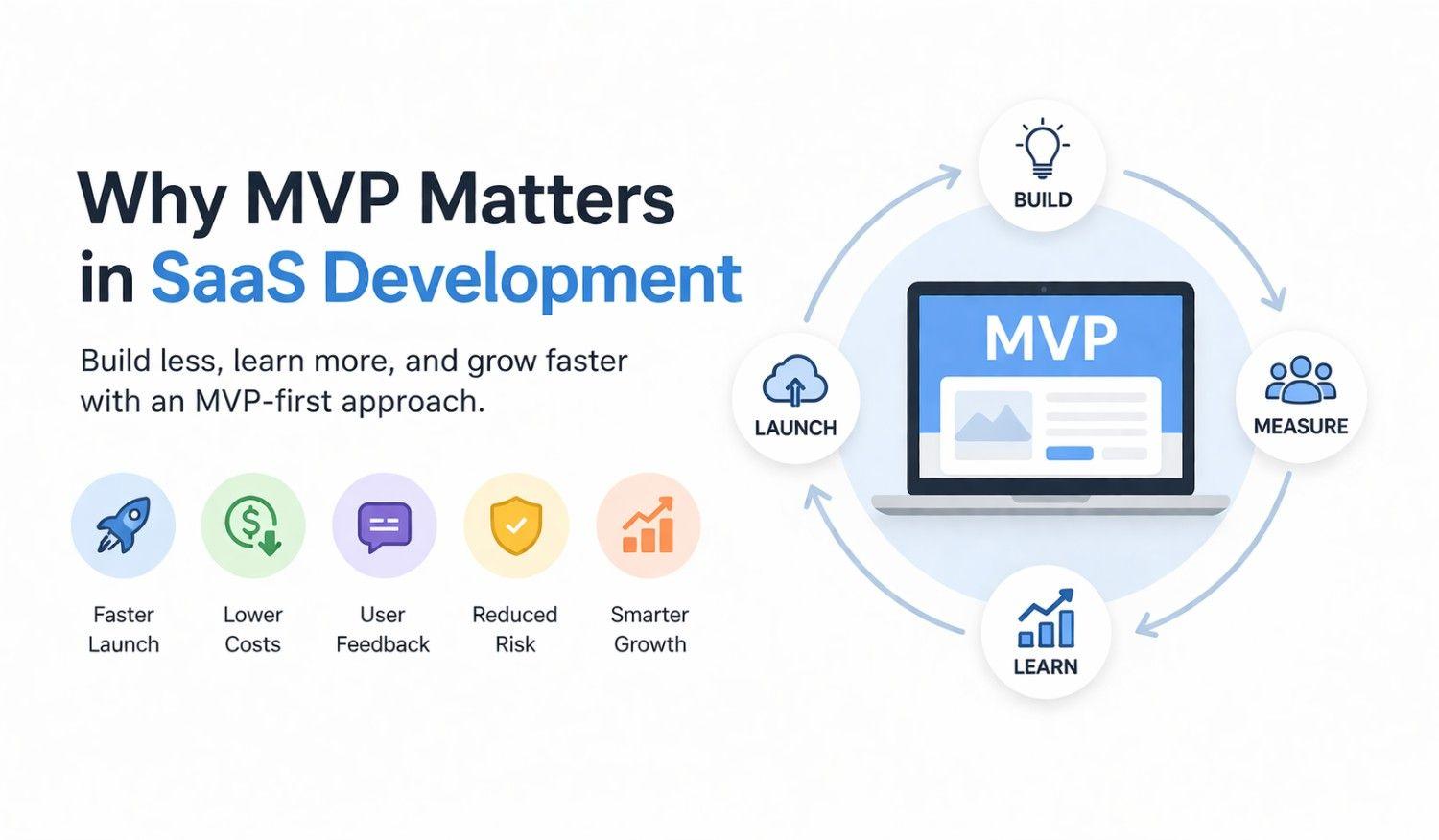
Why MVP Matters in SaaS Application Development
SaaS markets move quickly—sometimes uncomfortably so. Launch delays can mean missed opportunities, while overbuilding often results in wasted effort. MVP provides a structured way to enter the market without overcommitting resources. It enables teams to test assumptions, gather feedback, and refine their approach based on real-world usage. In other words, it replaces guesswork with insight. Many successful SaaS platforms began with simple versions that evolved over time. Starting small doesn’t limit ambition—it channels it more effectively (and keeps surprises manageable along the way).
Faster Time-to-Market
Speed often determines success in SaaS—and not just for competitive reasons. Releasing an MVP allows businesses to validate ideas quickly and establish an early presence in the market. Waiting for a “perfect” product can lead to endless development cycles (we’ve seen projects stuck in polishing mode for months—sometimes years). MVP cuts through that hesitation. By focusing only on essential features, teams can launch sooner, learn faster, and adapt more efficiently. In a landscape where timing matters, being early and adaptable often beats being late and flawless.
Cost Efficiency (Because Budgets Aren’t Infinite)
Budgets have limits—even if ambitions don’t. Developing a full-featured product upfront can drain resources before the product even reaches users. MVP helps control costs by focusing only on what’s necessary to validate the idea. Instead of investing heavily in features that might never be used, resources are allocated more wisely. This lean approach reduces financial risk while keeping development aligned with actual user needs. And yes, finance teams tend to appreciate this strategy (sometimes more than developers do—at least initially).
Real User Feedback (Not Assumptions)
Assumptions can be dangerous—especially in product development. MVP allows businesses to replace assumptions with real user insights. Once the product is in users’ hands, feedback becomes actionable data rather than speculation. This feedback loop enables continuous improvement, ensuring that future updates are driven by actual needs rather than internal guesses. Users often interact with products in unexpected ways (and occasionally ignore features entirely). MVP helps uncover these patterns early, making it easier to build something people genuinely want—not just something that looks impressive on paper.
Risk Reduction
Every product idea carries some level of uncertainty. MVP reduces that uncertainty by testing concepts before full-scale investment. Instead of committing to a complete build, businesses can evaluate performance, usability, and demand in real conditions. If adjustments are needed (and they usually are), they can be made early without significant losses. This approach minimizes the risk of launching a product that misses the mark. In SaaS, where competition is high, reducing risk isn’t just helpful—it’s essential for long-term sustainability.
Focus on Core Value Proposition
Feature overload is a common challenge in SaaS development. Teams often try to include everything—just in case. MVP forces a different mindset by emphasizing the core value proposition. What problem does the product solve? What feature delivers that solution most effectively? By narrowing the focus, MVP ensures clarity and purpose. This not only improves user experience but also simplifies development. After all, if everything is treated as a priority, nothing truly stands out (and users tend to notice that quickly).
How MVP Fits into Modern SaaS Strategy
Modern SaaS strategies revolve around agility, adaptability, and continuous improvement. MVP aligns perfectly with this approach by enabling iterative development and faster feedback cycles. It supports agile methodologies, allowing teams to build, test, and refine in manageable stages. Many businesses today rely on this model to scale efficiently and stay competitive. Working with an experienced saas application development company can further streamline this process, ensuring that MVPs are not only functional but also scalable. The goal isn’t just to launch—it’s to evolve intelligently over time.
Key Steps in MVP Development for SaaS
Developing an MVP involves a structured yet flexible approach. It begins with identifying the core problem—because without clarity, everything else becomes complicated. Next comes defining essential features (not the “nice-to-haves,” tempting as they may be). A prototype follows, offering a visual or functional preview. Then comes the launch—quick, focused, and purposeful. Finally, feedback is gathered and analyzed to guide improvements. Each step builds on the previous one, creating a cycle of learning and refinement that drives product success.
Common Mistakes to Avoid in MVP Development
Even MVPs can go wrong—surprisingly often. One common mistake is adding too many features, which defeats the purpose entirely. Another is ignoring user feedback, turning valuable insights into missed opportunities. Delaying the launch in pursuit of perfection is equally problematic (perfection, as it turns out, is quite elusive). Poor scalability planning can also create challenges later. Avoiding these pitfalls requires discipline and clarity. Because, in MVP development, doing less—but doing it right—often leads to better outcomes.
Real-World Observation (Kanhasoft Style)
A recent project highlighted an interesting pattern. A client initially requested a feature-rich platform with extensive integrations and complex workflows. After discussions (and a few reality checks), the focus shifted toward a lean MVP. The result? A faster launch, lower costs, and—perhaps most importantly—clear user feedback within weeks. Interestingly, some “must-have” features turned out to be unnecessary. Experiences like these reinforce a simple idea: building less at the start often leads to building better later. At Kanhasoft, this approach has proven effective time and again.
When Should You Build an MVP?
Timing plays a crucial role in product development. MVP is particularly valuable during early-stage development, when ideas need validation. It’s also useful when entering new markets or testing new features. Instead of committing fully to uncertain ideas, MVP offers a way to explore possibilities with minimal risk. Businesses looking to innovate without overextending resources often benefit from this approach. Starting small at the right time can create a strong foundation for future growth (and prevent unnecessary detours).
MVP vs Full Product: A Practical Comparison
An MVP focuses on essential functionality, while a full product includes a complete feature set. The difference lies in scope, time, and investment. MVPs are faster to build, more cost-effective, and easier to modify. Full products, on the other hand, require significant resources and longer development cycles. While both have their place, starting with an MVP provides flexibility and insight. It allows businesses to adapt before scaling, ensuring that expansion is based on validated success rather than assumptions.
How to Choose the Right Development Partner
Choosing the right development partner can significantly impact MVP success. Experience in SaaS, a strong understanding of agile practices, and a collaborative approach are key factors to consider. A reliable partner focuses not just on building features but on delivering value. Communication and transparency also play important roles. Working with a skilled team ensures that the MVP is aligned with business goals and user needs. Because, ultimately, the right guidance can turn a simple idea into a scalable product.
Conclusion
Building a SaaS product doesn’t require starting with everything—it requires starting with the right things. MVP offers a practical way to turn ideas into reality while staying flexible and efficient. It encourages learning, adaptation, and steady progress (rather than overwhelming complexity). In a world where speed and relevance matter, this approach provides a clear advantage. Because in SaaS, success rarely comes from building more—it comes from building smarter, one step at a time.
FAQs
1. What is MVP in SaaS application development?
An MVP is a simplified version of a SaaS product that includes only core features needed to solve a specific problem and gather user feedback.
2. Why is MVP important for startups?
MVP helps startups validate ideas quickly, reduce costs, and minimize risks before committing to full-scale development.
3. How long does MVP development take?
Development timelines vary, but most MVPs can be built within a few weeks to a few months, depending on complexity.
4. What features should an MVP include?
Only essential features that address the primary user problem should be included—nothing more, nothing less.
5. Can an MVP scale into a full product?
Yes, MVPs are designed to evolve into full products through continuous updates and improvements.
6. How does MVP reduce risk?
By testing ideas early with real users, MVP helps identify issues and opportunities before significant investment is made.

 English
 Arabic
 French
 Spanish
 Portuguese
 Deutsch
 Turkish
 Dutch
Dutch
 Italiano
 Russian
 Romaian
 Greek
Greek
