


Global Sodium Bicarbonate Market to Reach USD 2.65 Billion by 2034, Driven by 3.6% CAGR Growth
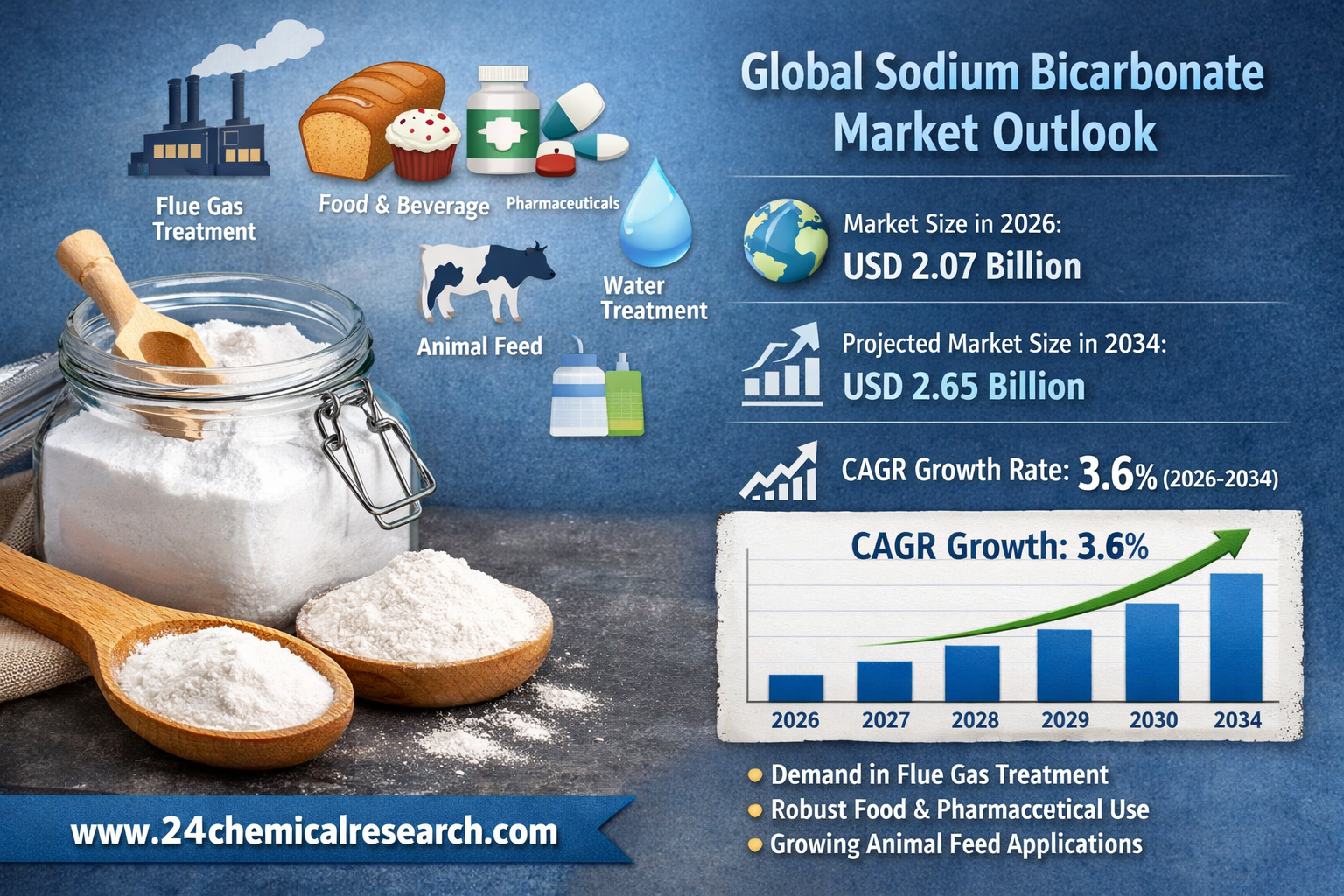
Global Sodium Bicarbonate market was valued at USD 2.07 billion in 2026 and is projected to reach USD 2.65 billion by 2034, exhibiting a steady CAGR of 3.6% during the forecast period.
Sodium bicarbonate, chemically known as NaHCO3 and widely recognized by its common name baking soda, is a remarkably versatile inorganic salt that has earned an indispensable role across a broad spectrum of industries. Characterized by its mild alkalinity, non-toxic nature, and excellent buffering capacity, this white crystalline powder serves as a leavening agent in food and beverages, an antacid and active pharmaceutical ingredient in medicine, a digestive aid in animal feed, a highly effective sorbent in flue gas treatment for air pollution control, and a trusted ingredient in personal care and household cleaning products. What makes sodium bicarbonate particularly compelling from a market perspective is not just the breadth of its applications, but the depth of demand across each of those verticals. Unlike many specialty chemicals that depend heavily on a single end-use sector, sodium bicarbonate benefits from a naturally diversified demand base—a structural advantage that provides resilience even in periods of economic uncertainty.
Get Full Report Here: https://www.24chemicalresearch.com/reports/306995/sodium-bicarbonate-market
Market Dynamics:
The market's trajectory is shaped by a complex interplay of powerful growth drivers, significant restraints that are being actively addressed, and vast, untapped opportunities. Understanding these forces is essential to appreciating not just where the market stands today, but where it is decisively headed over the coming decade.
Powerful Market Drivers Propelling Expansion
-
Escalating Demand in Flue Gas Treatment and Environmental Applications: One of the most compelling growth vectors for sodium bicarbonate is its expanding role in industrial emission control. As governments worldwide tighten regulations on sulfur dioxide (SO₂) and hydrogen chloride (HCl) emissions from coal-fired power plants, waste incineration facilities, and cement manufacturing operations, sodium bicarbonate has emerged as a preferred dry sorbent. Its effectiveness in neutralizing acidic gases without generating hazardous byproducts aligns perfectly with the global push for cleaner industrial processes. Water treatment applications are projected to grow at 5.2% CAGR through 2030, driven by stricter environmental regulations on wastewater pH balancing, further cementing sodium bicarbonate's position as a go-to solution for environmentally conscious industries. The compound's ability to react efficiently at lower temperatures compared to alternatives like hydrated lime makes it particularly attractive for retrofitting older industrial facilities seeking compliance without costly infrastructure overhauls.
-
Robust and Sustained Consumption in the Food and Beverage Industry: The global food processing sector continues to be the backbone of sodium bicarbonate demand, and this is unlikely to change anytime soon. With consumer preference shifting decisively toward convenience foods, the production of bread, cakes, biscuits, and savory snacks has increased by approximately 4.7% annually over the past three years. Sodium bicarbonate's role here is not merely functional—it is fundamental. As a leavening agent, it reacts with acidic components in dough or batter to produce carbon dioxide gas, creating the texture and volume consumers expect. Furthermore, the clean-label movement has worked in sodium bicarbonate's favor because it is perceived as a natural, recognizable ingredient rather than a synthetic chemical additive. Bakery manufacturers reformulating products in response to consumer demand for simpler ingredient lists are, in many cases, gravitating toward sodium bicarbonate rather than away from it. The bakery sector alone accounts for 42% of total food-grade demand, underscoring just how critical this end-use remains to overall market health.
-
Pharmaceutical Industry Expansion and Growing Medical Applications: Pharmaceutical applications account for nearly 22% of total sodium bicarbonate consumption, with antacids representing the single most prominent end-use within this segment. The growing prevalence of acid reflux, gastroesophageal reflux disease (GERD), and other acid-related gastrointestinal disorders—conditions increasingly linked to modern dietary habits and sedentary lifestyles—has sustained strong demand for antacid formulations in both developed and emerging markets. Global antacid sales surpassed USD 8 billion in 2023, reflecting a compound annual growth rate of 3.9% since 2020. Beyond antacids, sodium bicarbonate's utility in intravenous formulations for treating metabolic acidosis, its role in dialysis solutions, and emerging research into its application in certain oncology treatment protocols are all creating additional demand vectors that were not as pronounced a decade ago. The U.S. FDA cleared three new sodium bicarbonate-based medical devices in 2023 alone, a development that signals growing regulatory confidence in the compound's safety and therapeutic versatility.
Download FREE Sample Report: https://www.24chemicalresearch.com/download-sample/306995/sodium-bicarbonate-market
Significant Market Restraints Challenging Adoption
Despite its considerable strengths and the breadth of its application portfolio, the sodium bicarbonate market is not without its challenges. Several structural and operational restraints continue to temper growth and require strategic attention from producers and downstream users alike.
-
Raw Material Price Volatility and Input Cost Pressures: Sodium bicarbonate is produced primarily through the Solvay process, which relies heavily on soda ash (sodium carbonate) as its primary feedstock. Fluctuating prices of soda ash and carbon dioxide directly impact production economics. In Q3 2023 alone, soda ash prices varied by as much as 18% due to supply chain disruptions and energy market instability. This kind of volatility places manufacturers in a difficult position—they must either absorb cost increases, risking margin compression, or attempt to pass them on to customers who operate in price-sensitive commodity markets. Soda ash price volatility continues to impact margins, with Q1 2025 spot prices showing 12-15% fluctuation versus 2024 averages. Producers are increasingly implementing strategic sourcing initiatives, including vertical integration and long-term supply agreements, to mitigate this exposure. Environmental compliance investments add a further 3-5% to production costs in regulated markets, compounding the challenge for manufacturers operating under stringent regulatory frameworks.
-
Competition from Alternative Sorbents and Leavening Agents: While sodium bicarbonate holds a strong position across its core application segments, it does face meaningful competitive pressure in specific niches. In the environmental applications space, hydrated lime (calcium hydroxide) remains a well-established alternative for flue gas desulfurization, particularly in markets where cost sensitivity outweighs performance considerations. In the food segment, potassium bicarbonate and ammonium bicarbonate are gaining traction in health-conscious formulations, particularly where low-sodium positioning is a key marketing differentiator. These competitive dynamics do not threaten sodium bicarbonate's overall market leadership, but they do create pockets of demand erosion that producers must account for in their long-term commercial strategies.
Critical Market Challenges Requiring Innovation
Beyond the structural restraints, the sodium bicarbonate market contends with a set of operational and logistical challenges that add complexity to both production and distribution. As a hygroscopic material, sodium bicarbonate requires carefully controlled storage and handling conditions—particularly in humid environments. Southeast Asian markets, for instance, report 8-10% higher distribution costs compared to temperate regions, owing to the moisture control measures that must be applied during transit and warehousing. This logistical premium is non-trivial in markets where margins are already compressed by commodity pricing dynamics.
On the regulatory front, complying with evolving food safety standards across different geographies has become an increasingly resource-intensive undertaking. The EU's revised Food Additive Regulation (EC) No 1333/2008 has led to 12% longer approval timelines for new food contact applications since 2021, creating delays that can slow innovation cycles and increase time-to-market for new product formulations. Furthermore, while sodium bicarbonate is generally recognized as safe across major regulatory jurisdictions, maintaining compliance across a fragmented global regulatory landscape requires continuous investment in quality assurance, documentation, and certification management.
Vast Market Opportunities on the Horizon
-
Green Chemistry and Sustainable Industrial Processing: The global transition toward sustainable manufacturing is creating substantial new opportunities for sodium bicarbonate, particularly in industries seeking to reduce their environmental footprint without sacrificing operational effectiveness. Sodium bicarbonate is being used in 34% of new flue gas treatment systems installed in 2023, a figure that reflects both growing environmental awareness and the compound's proven efficacy as a clean sorbent. Its ability to neutralize acidic emissions without producing hazardous secondary waste streams is a significant advantage in markets where environmental compliance costs are rising. Beyond emission control, sodium bicarbonate blasting—a surface preparation technique that uses pressurized sodium bicarbonate in place of traditional abrasive media—is replacing conventional sandblasting in 17% of surface preparation projects in Europe, driven by its non-toxic properties and ability to clean surfaces without causing substrate damage. This application is growing particularly in the food processing, aerospace, and heritage conservation sectors, where material integrity and contamination control are paramount.
-
Expansion in Animal Nutrition and Livestock Feed Applications: The use of sodium bicarbonate in animal feed, particularly as a rumen buffer in dairy cattle nutrition, represents a well-established but still-growing application segment. As global meat and dairy production continues to expand in response to rising protein consumption in developing economies, demand for feed additives that improve animal health and productivity is increasing in parallel. Sodium bicarbonate helps maintain optimal rumen pH in high-producing dairy cows, improving feed efficiency and milk yield. Brazil represents a particularly strong growth market in this regard, with expanding livestock operations driving increasing adoption of sodium bicarbonate in animal nutrition applications. The compound's GRAS (Generally Recognized As Safe) status in major regulatory jurisdictions simplifies its integration into commercial feed formulations, lowering barriers to adoption among feed manufacturers.
-
Medical Grade Expansion and Emerging Therapeutic Applications: Emerging applications in dialysis solutions and cancer treatments are creating meaningful new revenue streams for high-purity pharmaceutical-grade sodium bicarbonate. The compound's role in managing metabolic acidosis in critically ill patients—a condition increasingly prevalent in intensive care unit settings—has brought it into the therapeutic mainstream in ways that extend well beyond its traditional over-the-counter antacid positioning. Manufacturers are responding to this opportunity by investing in dedicated pharmaceutical-grade production lines capable of meeting the stringent purity specifications required by hospital formularies and pharmaceutical compounders. The Middle East is emerging as a particularly strategic hub for capacity expansion, with new production facilities in Saudi Arabia reducing regional import dependence by 28% since 2022—a development that reflects both the region's growing healthcare infrastructure and its commitment to reducing reliance on imported specialty chemicals.
In-Depth Segment Analysis: Where is the Growth Concentrated?
By Type:
The market is segmented into Technical Grade, Medical Grade, and Food Grade sodium bicarbonate. Food Grade sodium bicarbonate currently leads the market by value and volume, favored for its stringent purity standards and widespread applicability across the bakery, beverage, and food processing industries. Medical grade is witnessing steady growth driven by expanding pharmaceutical and clinical applications, where purity and consistency are non-negotiable. Technical grade, while less glamorous from a margin perspective, maintains solid relevance across a range of industrial processes including flue gas treatment, leather tanning, textile processing, and rubber manufacturing, providing a stable base load of demand that anchors overall market volumes.
By Application:
Application segments include the Food Industry, Pharmaceutical Industry, Feed Industry, Flue Gas Treatment, and others. The Food Industry segment currently dominates overall consumption, anchored by the global bakery sector's consistent reliance on sodium bicarbonate as a primary leavening agent. However, the Flue Gas Treatment segment is emerging as one of the fastest-growing application areas, propelled by regulatory mandates on industrial emissions across North America, Europe, and increasingly across Asia-Pacific. Pharmaceutical applications provide a steady and growing demand base, with manufacturers increasingly focusing on high-purity production capabilities to capture margin-rich pharmaceutical contracts. Animal feed applications, while smaller in absolute terms, are growing meaningfully in emerging markets with expanding livestock industries.
By Production Method:
The production landscape is segmented into the Synthetic Method (primarily the Solvay process), the Natural Alkali Method, and the Metathesis Method. The Synthetic Method remains predominant globally, underpinned by the well-established industrial infrastructure built around the Solvay process over more than a century of commercial production. However, the Natural Alkali Method—which involves processing naturally occurring trona ore deposits—is gaining meaningful traction in markets where environmental sustainability is a key procurement criterion. Producers like Natural Soda in the United States leverage trona-based production to offer a lower-carbon footprint product that resonates with environmentally conscious buyers. The Metathesis Method serves niche high-purity applications but faces scalability challenges that currently limit its broader commercial uptake.
Download FREE Sample Report: https://www.24chemicalresearch.com/download-sample/306995/sodium-bicarbonate-market
Competitive Landscape:
The global Sodium Bicarbonate market features a mix of multinational chemical corporations and regional specialists, with Solvay (Belgium), Church & Dwight (United States), and Tata Chemicals (India) leading in production capacity, technological capabilities, and global distribution reach. These established players maintain their competitive positions through integrated supply chains, diversified end-market exposure, and continuous investment in product quality and application development. The industry exhibits moderate consolidation, with the top five producers accounting for approximately 35-40% of global output. Pricing dynamics remain competitive given the commodity nature of standard grades, though pharmaceutical and food-grade products command meaningfully higher margins that reward producers with proven quality management systems and regulatory compliance capabilities.
Emerging producers from China and India are gaining traction through cost-competitive operations. Inner Mongolia Yuan Xing Energy and Qingdao Soda Ash, for instance, have expanded their footprints significantly, focusing primarily on industrial-grade supply for domestic and regional markets. China now represents 31% of global production capacity, with ongoing capacity expansions reflecting the country's strategic interest in maintaining leadership across key industrial chemical sectors. Meanwhile, specialized producers like Natural Soda in the United States leverage sustainable trona-based mining techniques to differentiate their product offering in environmentally sensitive markets, commanding a pricing premium that reflects the growing value buyers place on greener supply chains. The competitive strategy across the industry is increasingly focused on application development partnerships with key end-users, vertical integration to stabilize input costs, and investment in pharmaceutical-grade capabilities to access higher-margin market segments.
List of Key Sodium Bicarbonate Companies Profiled:
-
Solvay (Belgium)
-
Church & Dwight (United States)
-
Tata Chemicals (India)
-
FMC Corporation (United States)
-
Asahi Glass (Japan)
-
Tosoh Corporation (Japan)
-
Noah Technologies (United States)
-
Inner Mongolia Yuan Xing Energy (China)
-
Aijie Group (China)
-
Haihua Group (China)
-
Qingdao Soda Ash (China)
-
Natural Soda (United States)
The competitive strategy across leading players is overwhelmingly focused on enhancing product purity and consistency to capture premium pharmaceutical and food-grade contracts, alongside forming strategic partnerships with key end-users to co-develop application-specific solutions in flue gas treatment and animal nutrition. Vertical integration initiatives aimed at stabilizing soda ash input costs are also a defining theme of competitive strategy in the current market environment.
Regional Analysis: A Global Footprint with Distinct Leaders
-
Asia-Pacific: Is the dominant regional force in the global sodium bicarbonate market, led emphatically by China's massive production base and India's rapidly growing consumption across pharmaceutical, food processing, and industrial applications. China's extensive soda ash reserves and mature chemical manufacturing infrastructure support large-scale, cost-competitive production that serves both domestic demand and export markets. India's market is expanding rapidly, driven by pharmaceutical industry growth, increasing food processing activity, and government initiatives to develop the country's chemical sector. Southeast Asian nations including Indonesia and Vietnam are also contributing meaningfully to regional demand growth, particularly in feed and food processing applications, as their agricultural and food manufacturing sectors modernize and scale. Stricter environmental policies in Japan and South Korea are further boosting demand for sodium bicarbonate in industrial emission treatment systems, adding an important regulatory tailwind to the region's market dynamics.
-
North America: Maintains a strong and technologically sophisticated market position, anchored by the United States' well-established food processing, pharmaceutical, and environmental compliance sectors. The region is characterized by a premium pricing environment—North America commands a pricing premium of approximately 18% above the global average for pharmaceutical-grade sodium bicarbonate—reflecting both the high purity standards required by its regulatory framework and the sophisticated end-user base that relies on consistent, high-quality supply. Natural Soda's trona-based production operations in Wyoming represent a uniquely American competitive advantage, offering buyers a domestically sourced, naturally derived product with a compelling environmental profile. Environmental regulations continue to support flue gas treatment demand, while the mature bakery and processed food industries sustain reliable base-load consumption.
-
Europe: Features some of the most stringent quality and environmental standards in the world, which simultaneously creates compliance burdens and competitive differentiation opportunities for producers capable of meeting those standards consistently. Germany and France lead regional consumption, with growing emphasis on eco-friendly industrial processes across manufacturing sectors boosting demand for sodium bicarbonate as a clean processing aid and emission control sorbent. The region's preference for natural alkalinization methods in food processing is also worth noting, as it has driven interest in naturally sourced sodium bicarbonate among premium food manufacturers seeking to align with clean-label and sustainability commitments. Eastern European countries represent an emerging growth frontier, with expanding chemical manufacturing capacity and rising environmental compliance requirements driving increased adoption across multiple application segments.
-
South America & Middle East and Africa: These regions collectively represent the emerging frontier of the global sodium bicarbonate market. Brazil leads South American consumption, with expanding livestock feed applications and a growing pharmaceutical sector providing the primary demand drivers. Argentina shows potential in agricultural and food processing applications, though economic volatility has tempered near-term growth expectations. In the Middle East and Africa, niche growth opportunities are emerging across water treatment, oilfield applications, and pharmaceutical consumption. The Middle East is gaining particular strategic importance as a production hub, with new manufacturing capacity in Saudi Arabia reducing the region's historical reliance on imports—a development that reflects both the region's industrial ambitions and the commercial opportunity represented by its growing domestic consumption base.
Get Full Report Here: https://www.24chemicalresearch.com/reports/306995/sodium-bicarbonate-market
Download FREE Sample Report: https://www.24chemicalresearch.com/download-sample/306995/sodium-bicarbonate-market
About 24chemicalresearch
Founded in 2015, 24chemicalresearch has rapidly established itself as a leader in chemical market intelligence, serving clients including over 30 Fortune 500 companies. We provide data-driven insights through rigorous research methodologies, addressing key industry factors such as government policy, emerging technologies, and competitive landscapes.
-
Plant-level capacity tracking
-
Real-time price monitoring
-
Techno-economic feasibility studies
International: +1(332) 2424 294 | Asia: +91 9169162030
Website: https://www.24chemicalresearch.com/

 English
 French
 Spanish
 Portuguese
 Deutsch
 Turkish
 Dutch
Dutch
 Italiano
 Russian
 Romaian
 Portuguese (Brazil)
 Greek
Greek
