


Digital Textile Printing Market Trends in Smart Printing Solutions
The Evolution of Digital Textile Printing
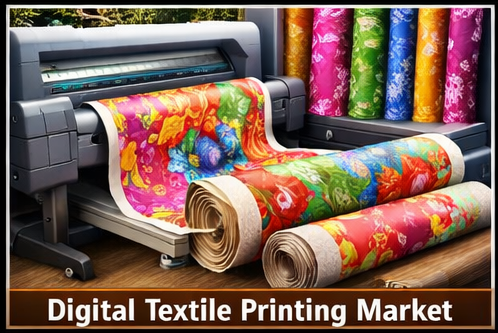
Digital textile printing has rapidly transitioned from a niche innovation to a core production method in modern textile manufacturing. As brands demand faster turnaround times, customization, and sustainable processes, technologies such as digital fabric printing and advanced textile printer systems are redefining how fabrics are designed and produced. Unlike traditional methods, digital textile printing eliminates lengthy setup processes, enabling short runs and on-demand production with remarkable precision.
One of the most significant shifts is the increasing adoption of high-speed textile printer machines capable of handling large volumes without compromising quality. These machines support intricate patterns, vibrant colors, and photorealistic designs, making them highly suitable for fashion, home décor, and even technical textiles. The integration of automation and smart workflows has further enhanced efficiency, allowing manufacturers to streamline operations while reducing waste.
Technology-Driven Advancements in Printing Methods
Recent advancements in digital fabric printing technologies are shaping the industry’s future. Sublimation textile printing, for instance, has gained considerable traction due to its ability to produce durable, high-resolution prints on polyester-based fabrics. This method ensures color vibrancy and wash resistance, making it a preferred choice for sportswear and soft signage applications.
At the same time, digital screen printing is evolving as a hybrid approach that combines the benefits of traditional screen printing with digital precision. This innovation allows manufacturers to maintain consistency in bulk production while leveraging digital flexibility for complex designs. Additionally, pigment-based inks are becoming more popular in digital textile printing, as they require less water and energy compared to reactive or acid inks, aligning with global sustainability goals.
Artificial intelligence and machine learning are also playing a growing role. These technologies enable predictive maintenance for textile printer systems, optimize ink usage, and enhance color matching accuracy. As a result, businesses can achieve higher productivity with reduced operational costs.
Sustainability and Customization as Core Drivers
Sustainability has become a defining factor in the growth of digital textile printing. Traditional textile processes are often water-intensive and generate significant chemical waste. In contrast, digital fabric printing minimizes resource consumption by applying ink only where needed. Sublimation textile printing further supports eco-friendly practices by eliminating water usage in the transfer process.
Customization is another major driver. Consumers increasingly seek personalized products, and digital textile printing enables brands to offer unique designs without the constraints of mass production. From customized apparel to bespoke interior fabrics, the ability to print on demand is transforming the value chain.
E-commerce platforms are amplifying this trend by integrating digital textile printing directly into their fulfillment systems. This allows businesses to produce and ship customized products quickly, reducing inventory costs and improving customer satisfaction. As a result, digital screen printing and other hybrid solutions are becoming essential tools for meeting dynamic consumer demands.
Market Momentum and Future Outlook
The growth trajectory of digital textile printing reflects its expanding applications and technological maturity. Mentioning in research report by Grand View Research, the global digital textile printing market size is projected to reach USD 11,596.4 million by 2030, growing at a CAGR of 12.7% from 2025 to 2030. This projection underscores the increasing reliance on digital solutions across the textile ecosystem.
In practical terms, this growth is being driven by continuous innovation in textile printer hardware, improved ink formulations, and the expansion of sublimation textile printing into new material segments. The industry is also witnessing a rise in direct-to-garment (DTG) and direct-to-fabric (DTF) technologies, which further enhance the versatility of digital fabric printing.
Looking ahead, the convergence of sustainability, automation, and customization will continue to define the future of digital textile printing. Manufacturers that invest in advanced digital screen printing systems and scalable textile printer solutions will be better positioned to adapt to evolving market demands. As technology advances, the gap between digital and traditional methods will narrow further, making digital textile printing the standard for efficient, sustainable, and high-quality textile production.
In essence, digital textile printing is no longer just an alternative—it is becoming the foundation of modern textile innovation.

 English
 Arabic
 French
 Spanish
 Portuguese
 Deutsch
 Turkish
 Italiano
 Russian
 Romaian
 Portuguese (Brazil)
 Greek
Greek
