


How Does Electrospinning Work? A Step-by-Step Breakdown
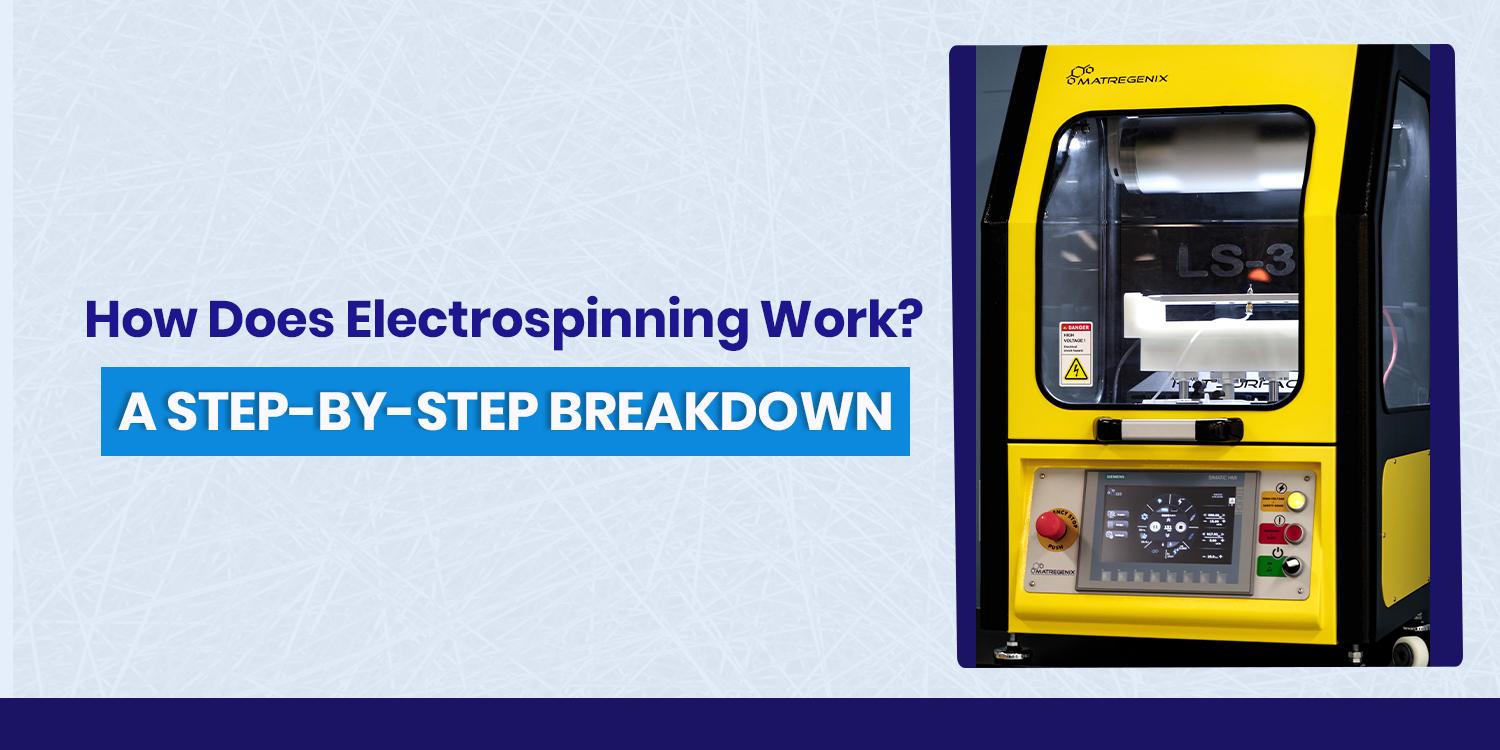
Electrospinning is a fascinating and highly versatile technique used to produce ultra-fine fibers, often at the nanoscale. These nanofibers are widely applied in fields like biomedical engineering, filtration, energy storage, and textiles. But how does electrospinning actually work?
In this guide by Matregenix, we’ll walk through the electrospinning process step by step, breaking down the science into simple, easy-to-understand stages.
What Is Electrospinning?
Electrospinning is a method that uses electrical forces to create very thin fibers from a liquid polymer solution or melt. By applying a high-voltage electric field, the liquid is stretched into continuous fibers that solidify and form a nonwoven mat.
What makes this process remarkable is its ability to produce fibers that are thousands of times thinner than a human hair.
Key Components of an Electrospinning Setup
Before diving into the steps, it’s important to understand the basic components involved:
- Syringe or spinneret – Holds the polymer solution
- High-voltage power supply – Creates the electric field
- Collector – A grounded surface where fibers accumulate
- Pump system – Controls the flow rate of the solution
Each of these elements plays a crucial role in ensuring smooth and consistent fiber formation.
Step-by-Step Breakdown of Electrospinning
Step 1: Preparing the Polymer Solution
The process begins with preparing a polymer solution or melt. The choice of polymer depends on the desired application common materials include synthetic polymers, natural biopolymers, or composites.
The solution must have the right viscosity and conductivity. If it’s too thick, it won’t flow properly; if it’s too thin, it won’t form stable fibers. Achieving the right balance is key.
Step 2: Loading the Solution into the Syringe
Once the solution is ready, it is loaded into a syringe connected to a fine needle (spinneret). A pump is used to control the rate at which the solution is pushed out.
Precision at this stage ensures consistent fiber diameter and uniformity later in the process.
Step 3: Applying High Voltage
A high-voltage power supply is connected to the needle, while the collector is grounded. When voltage is applied, an electric field forms between the needle tip and the collector.
This electric field creates a force that acts on the liquid droplet at the needle tip, preparing it for fiber formation.
Step 4: Formation of the Taylor Cone
As the electric field strength increases, the droplet of polymer solution begins to deform into a shaped structure known as the Taylor cone.
At a critical voltage, the electrostatic forces overcome the surface tension of the liquid. This is the turning point where the process shifts from a static droplet to dynamic fiber formation.
Step 5: Jet Ejection
Once the force is strong enough, a fine jet of liquid is ejected from the tip of the Taylor cone. This jet is extremely thin and highly charged.
As it travels through the air, the jet undergoes rapid stretching and elongation due to electrostatic repulsion within the charged fluid.
Step 6: Solvent Evaporation
While the jet is in motion, the solvent in the polymer solution begins to evaporate. This causes the liquid jet to solidify into a thin fiber.
Environmental conditions such as temperature and humidity can significantly influence this stage. Controlled conditions help achieve better fiber quality.
Step 7: Fiber Collection
Finally, the solidified fibers are collected on a grounded surface, often a rotating drum or flat plate. Over time, these fibers accumulate into a nonwoven mat with a unique structure and high surface area.
This mat can then be further processed or directly used depending on the application.
Why Electrospinning Matters
Electrospinning stands out because of its simplicity and scalability. Despite involving high voltage, the setup is relatively straightforward and can be adapted for both laboratory research and industrial production.
At Matregenix, electrospinning is leveraged to develop advanced nanofiber materials tailored for specific applications. From medical scaffolds to high-performance filters, the possibilities are vast.
Applications of Electrospun Nanofibers
Electrospun fibers are used in a wide range of industries, including:
- Biomedical – Tissue engineering, drug delivery, wound dressings
- Filtration – Air and water purification systems
- Energy – Batteries, fuel cells, and solar devices
- Textiles – Smart fabrics and protective clothing
Their high surface area, porosity, and tunable properties make them incredibly valuable.
Final Thoughts
Electrospinning may sound complex, but when broken down into steps, it becomes much easier to understand. From preparing the polymer solution to collecting the final fibers, each stage plays a critical role in producing high-quality nanofibers.
As industries continue to demand lighter, stronger, and more efficient materials, electrospinning will remain a key technology driving innovation. With expertise from companies like Matregenix, the future of nanofiber production looks both promising and transformative.

 English
 Arabic
 French
 Spanish
 Portuguese
 Deutsch
 Turkish
 Italiano
 Russian
 Romaian
 Portuguese (Brazil)
 Greek
Greek
