


AI and Automation in Connected TV Advertising Strategies
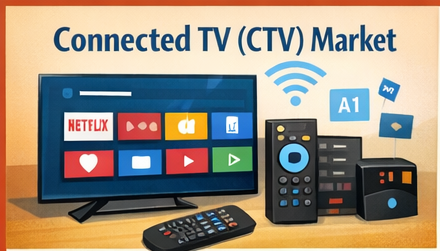
The Rapid Rise of Connected TV in the Digital Era
The evolution of connected TV has fundamentally transformed how audiences consume content, shifting away from traditional broadcasting toward internet-driven viewing. A smart TV, integrated with high-speed connectivity and app ecosystems, now acts as the central hub of home entertainment. With the surge of OTT streaming, viewers increasingly prefer on-demand, personalized experiences over scheduled programming.
This shift is not just behavioral—it is structural. CTV platforms such as streaming apps and device ecosystems are redefining distribution, while advertisers follow audiences into these digital environments. As a result, CTV advertising is becoming one of the fastest-growing segments in digital media, combining television-scale reach with data-driven precision.
Market Momentum and Growth Outlook
The expansion of the connected TV ecosystem is supported by strong market fundamentals. Report published by Grand View Research. indicates that the global connected TV market is projected to reach USD 530.90 billion by 2030, growing at a CAGR of 12.80% from 2025 to 2030.
This growth is driven by the widespread adoption of streaming services, improved broadband infrastructure, and the increasing affordability of advanced smart TV technologies. As consumers transition from cable to OTT streaming, connected TV devices have become the preferred medium for premium content consumption. Features such as 4K resolution, AI-powered recommendations, and seamless app integration are accelerating this adoption globally.
In markets like India and across Asia-Pacific, rising disposable incomes and expanding internet penetration are further strengthening demand for connected TV solutions, positioning the region as a high-growth hub.
How CTV Advertising Is Reshaping Media Strategy
One of the most significant transformations within this ecosystem is the rise of CTV advertising. Unlike traditional TV ads, CTV enables precise audience targeting, real-time performance tracking, and programmatic buying. This convergence of digital and television capabilities is attracting brands that demand measurable ROI.
Recent industry insights highlight that connected TV viewership is growing rapidly, with ad impressions increasing significantly as brands shift budgets from linear TV to streaming environments. This reflects a broader trend: advertisers are prioritizing platforms where audiences are actively engaged.
From a practitioner perspective, the appeal is clear—but not without complexity. As one industry discussion noted:
“The reach is incredible… but managing it at scale is difficult.”
This highlights a key operational challenge—fragmentation across multiple CTV platforms, measurement inconsistencies, and the need for unified data strategies. Still, the ability of CTV to merge storytelling with precision targeting makes it indispensable in modern media planning.
The Convergence of Content, Creators, and Platforms
Another defining trend is the convergence between traditional television and digital-first content. Platforms like YouTube are increasingly consumed via connected TV devices, with a significant share of viewing happening on large screens.
This shift is blurring the lines between broadcast and digital ecosystems. Creator-led content, once confined to mobile and desktop, is now a core part of the living room experience. For advertisers, this means expanding strategies beyond conventional formats to include influencer-driven and hybrid video content across CTV platforms.
At the same time, advancements in AI and machine learning are enhancing personalization across smart TV interfaces. Viewers are presented with highly curated recommendations, increasing engagement and session duration—key metrics for both content providers and advertisers.
Integrated Market Insight and Future Direction
The global connected TV market continues to evolve as a critical pillar of the digital economy, driven by the integration of hardware, software, and content ecosystems. It encompasses internet-enabled televisions and devices that deliver streaming content while enabling advanced advertising capabilities. As demand for seamless viewing experiences grows, connected TV, OTT streaming, and CTV advertising are becoming deeply interconnected.
The market’s purpose extends beyond entertainment—it enables data-driven engagement, supports targeted advertising, and enhances user experience through personalization. With rapid innovation in CTV platforms, the industry is positioned to deliver scalable growth opportunities for both technology providers and marketers.
Looking ahead, the trajectory of connected TV will be shaped by three forces: continued growth in streaming adoption, the maturation of programmatic CTV advertising, and deeper integration with smart home ecosystems. As these elements converge, connected TV is no longer just a device—it is the centerpiece of the modern digital media landscape.

 English
 Arabic
 French
 Spanish
 Portuguese
 Deutsch
 Turkish
 Dutch
Dutch
 Russian
 Romaian
 Portuguese (Brazil)
 Greek
Greek
