


Types of regression testing for end-to-end software workflows
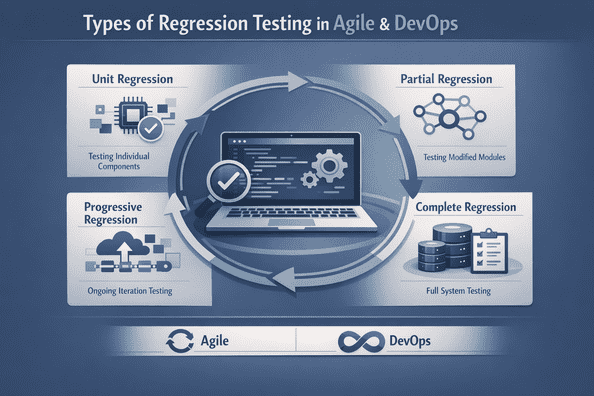
In modern software development, ensuring that new updates do not break existing functionality is crucial. End-to-end workflows often span multiple modules, systems, and integrations, making comprehensive validation essential. Understanding the types of regression testing helps QA teams efficiently maintain software stability while supporting continuous development.
By applying the right regression testing approach, teams can identify defects early, improve test coverage, and maintain confidence in complex software systems.
Why Regression Testing Matters in End-to-End Workflows
End-to-end workflows involve multiple user interactions, APIs, databases, and external integrations. Frequent changes in these systems can introduce:
- Unintended defects
- Broken business processes
- Integration failures
- Degraded user experience
Regression testing ensures that existing workflows continue to function as expected, even as new features are added.
What Is Regression Testing
Regression testing is the process of re-executing existing test cases to verify that recent code changes have not negatively impacted existing functionality.
Key Objectives
- Detect defects introduced by changes
- Maintain system reliability
- Ensure consistent functionality across versions
Different workflows may require different regression testing approaches, which is why understanding the types of regression testing is important.
Key Types of Regression Testing for End-to-End Workflows
1 Corrective Regression Testing
Used when no significant changes have been made to the software.
When to Use:
- Minor bug fixes or patches
- No changes to existing functionality
Benefits:
- Quick and simple
- No need to create new test cases
- Confirms stability of existing features
2 Retest-All Regression Testing
Involves testing the entire system after major changes.
When to Use:
- After major releases or significant feature additions
Benefits:
- Comprehensive validation
- Ensures end-to-end workflow integrity
- Detects hidden defects across modules
3 Selective Regression Testing
Focuses only on test cases impacted by recent changes.
When to Use:
- When changes are limited to certain modules
- To reduce execution time
Benefits:
- Efficient and faster execution
- Optimized use of QA resources
- Ensures critical areas are validated
4 Progressive Regression Testing
Used when new test cases are introduced due to updated or additional functionality.
When to Use:
- New features added to existing workflows
Benefits:
- Ensures new functionality works with existing features
- Maintains end-to-end workflow consistency
5 Partial Regression Testing
Validates modified areas along with their dependent components.
When to Use:
- Changes affect specific parts of the workflow
- Dependencies exist between modules
Benefits:
- Targeted testing for impacted areas
- Reduces unnecessary test execution
- Maintains workflow reliability
How Regression Testing Supports End-to-End Workflows
- Ensures critical business processes function as intended
- Validates interactions between different modules and systems
- Detects defects before they impact users
- Provides confidence in software updates
Understanding the fundamentals of software testing and applying the right regression type ensures effective validation in complex workflows.
Role of Automation in Regression Testing
Manual testing alone is insufficient for end-to-end workflows due to their complexity.
Automation Benefits:
- Executes regression tests rapidly
- Provides consistent results
- Integrates with CI/CD pipelines
- Frees QA teams to focus on exploratory testing
Automation frameworks enhance regression testing, making it scalable and reliable across large applications.
Best Practices for Effective Regression Testing
- Prioritize test cases based on risk and impact
- Use a combination of selective and retest-all regression strategies
- Maintain and update test suites regularly
- Automate repetitive and high-value test cases
- Monitor test results and adjust strategies as needed
These practices ensure comprehensive and efficient regression coverage.
Real World Example
Consider a financial application with an end-to-end workflow for payments:
Scenario Without Regression Testing:
- New feature introduces errors in account balance calculations
- Users encounter failed transactions
- Reduced trust and increased support tickets
Scenario With Proper Regression Testing:
- Automated and selective regression tests validate critical workflows
- Integration points and dependencies are verified
- System remains stable and user experience is preserved
This illustrates how regression testing safeguards complex workflows.
Conclusion
Understanding the types of regression testing is essential for maintaining reliable end-to-end software workflows. By selecting the appropriate regression type and leveraging automation, QA teams can ensure stability, reduce risk, and deliver high-quality software consistently.
Effective regression testing not only preserves functionality but also enables teams to innovate confidently, knowing that existing workflows remain intact.

 English
 Arabic
 French
 Spanish
 Portuguese
 Deutsch
 Turkish
 Dutch
Dutch
 Italiano
 Romaian
 Portuguese (Brazil)
 Greek
Greek
