


How TDD vs BDD Support Long Term Scalability and Growth?
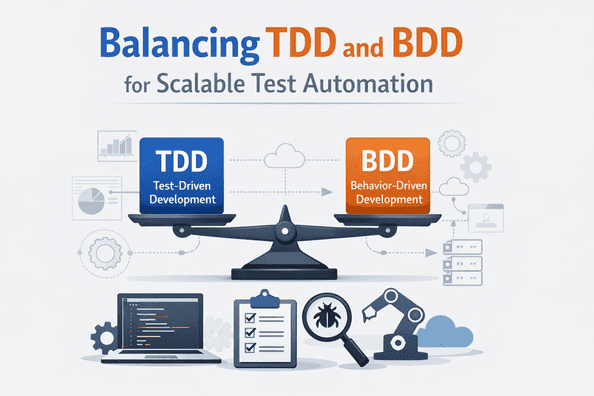
As software systems evolve, scalability and long-term growth become critical concerns for development teams. Building features quickly is important—but sustaining performance, maintainability, and quality over time is what truly defines success. This is where understanding tdd vs bdd becomes highly valuable.
Both Test-Driven Development and Behavior-Driven Development influence not just how software is built, but how it scales and adapts to future requirements. In this article, we’ll explore how tdd vs bdd supports long-term scalability and growth in modern applications.
Why Scalability and Growth Matter
Modern applications must handle:
- Increasing user demand
- Expanding feature sets
- Complex integrations
- Frequent updates
Without a strong foundation, systems become difficult to maintain and scale.
How TDD Supports Long Term Scalability
TDD focuses on writing tests before code, which naturally leads to better design decisions.
1 Encourages Modular Architecture
TDD promotes small, independent units of code.
Impact
- Easier to scale individual components
- Reduced system complexity
- Improved maintainability
Result
Applications can grow without becoming unmanageable.
2 Improves Code Quality
TDD ensures that code is tested at every step.
Benefits
- Fewer defects
- Cleaner implementation
- Better reliability
High-quality code is essential for scalable systems.
3 Enables Safe Refactoring
As systems grow, code needs to evolve.
How TDD Helps
- Tests act as a safety net
- Changes can be made confidently
- Risk of breaking functionality is reduced
This allows continuous improvement without instability.
4 Supports Continuous Development
TDD integrates seamlessly into iterative development.
Outcome
- Faster feedback loops
- Incremental improvements
- Sustainable growth
This aligns well with scalable development practices.
How BDD Supports Long Term Growth
BDD focuses on defining system behavior and aligning development with business goals.
1 Aligns Development with Business Needs
BDD ensures that features are built based on real-world scenarios.
Impact
- Reduces unnecessary features
- Improves product relevance
- Supports strategic growth
Result
Systems evolve in the right direction.
2 Improves Communication Across Teams
BDD involves developers, testers, and stakeholders.
Benefits
- Clear understanding of requirements
- Reduced miscommunication
- Better collaboration
This ensures smoother scaling of both teams and systems.
3 Enhances Test Readability and Maintainability
BDD scenarios are easy to understand and maintain.
Outcome
- Easier onboarding for new team members
- Long-term sustainability of test suites
- Improved documentation
Readable tests support long-term growth.
4 Validates End to End Workflows
BDD ensures that complete user journeys work correctly.
Impact
- Better user experience
- Reliable business workflows
- Reduced production issues
This is essential for scaling applications.
Combining TDD vs BDD for Scalable Systems
The real strength lies in using both approaches together.
How They Complement Each Other
- TDD ensures technical correctness
- BDD ensures functional and business correctness
Example Workflow
1 Define expected behavior using BDD scenarios
2 Break features into smaller components
3 Use TDD to implement each component
4 Continuously validate through automated tests
This approach ensures both technical and functional scalability.
Role in Software Testing
A strong foundation in software testing is essential to fully leverage tdd vs bdd.
These approaches enhance testing by:
- Ensuring continuous validation
- Improving test coverage
- Supporting automation strategies
They extend traditional testing practices into development workflows.
Benefits for Long Term Growth
Using tdd vs bdd provides several advantages:
- Improved system scalability
- Reduced technical debt
- Faster feature delivery
- Higher code quality
- Better collaboration across teams
These benefits contribute directly to sustainable growth.
Common Challenges
Teams may face challenges such as:
- Initial learning curve
- Increased upfront effort
- Maintaining large test suites
- Balancing speed and quality
Addressing these challenges requires experience and discipline.
Best Practices for Implementation
To maximize scalability and growth:
- Start with small features and scale gradually
- Keep tests simple and focused
- Maintain and update test suites regularly
- Integrate testing into CI CD pipelines
- Encourage collaboration between teams
These practices ensure long-term success.
Role of Modern Tools
Modern tools support TDD and BDD by:
- Automating test execution
- Managing test cases and scenarios
- Integrating with development pipelines
For example, platforms like Keploy can generate test cases from real API interactions, helping teams maintain scalable and reliable systems.
Real World Example
Consider a SaaS platform experiencing rapid growth.
Without TDD and BDD
- Code becomes difficult to maintain
- Frequent bugs slow down development
- Scaling becomes challenging
With TDD and BDD
- Modular and well-tested codebase
- Clear and validated workflows
- Smooth scalability and faster growth
This highlights the long-term impact of structured testing practices.
Conclusion
Understanding how tdd vs bdd supports long-term scalability and growth is essential for modern development teams. TDD builds a strong technical foundation with clean and reliable code, while BDD ensures alignment with business needs and user expectations.
Together, they enable systems to grow sustainably, adapt to change, and deliver consistent value over time—making them key practices for building scalable and future-ready software.

 English
 Arabic
 French
 Spanish
 Portuguese
 Turkish
 Dutch
Dutch
 Italiano
 Russian
 Romaian
 Portuguese (Brazil)
 Greek
Greek
