


Projection Welding: Precision Metal Joining for Modern Manufacturing
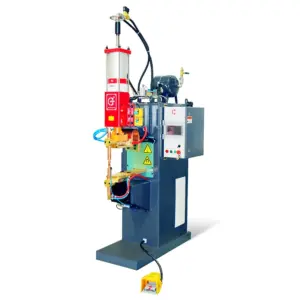
In today’s fast-paced manufacturing environment, achieving strong, precise, and repeatable welds is essential for industrial production. Among the range of resistance welding techniques, projection welding stands out for its ability to deliver consistent results for complex assemblies. Heron Welder, a global leader in industrial welding and metal-joining equipment, provides advanced projection welding machines designed to meet the needs of OEMs, automation integrators, and manufacturing engineers worldwide.
What is Projection Welding?
Projection welding is a type of resistance welding that uses localized projections on one or both workpieces to concentrate current flow and pressure at precise points. Unlike spot welding, where electrodes are applied directly to a flat surface, projection welding relies on these raised points to focus heat and create welds with consistent depth and strength.
This method is particularly effective for joining thick plates, multi-layer assemblies, or components with complex geometries, where uniform energy distribution is critical.
How Projection Welding Works
The projection welding process combines heat and pressure in a controlled manner:
-
Preparation: Workpieces are designed with small projections (typically embossed or stamped) on the contact surfaces.
-
Electrode Application: Electrodes press the pieces together, applying uniform force over the welding area.
-
Current Flow: An electric current passes through the projections, generating heat due to electrical resistance.
-
Material Fusion: The heat causes the metal at the projection tips to melt, forming a strong weld nugget as the electrodes hold the pieces in place.
-
Cooling: The weld solidifies quickly under pressure, ensuring structural integrity.
Heron’s MFDC and medium-frequency projection welding machines provide precise control of current, force, and timing, enabling high-quality welds for demanding industrial applications.
Key Applications of Projection Welding
Projection welding is widely used in industries where durable, repeatable joints are critical:
-
Automotive Manufacturing: Welding nuts, fasteners, brackets, and battery tabs.
-
Electrical Components: Joining connectors, terminals, and laminated cores.
-
Industrial Machinery: Fabricating heavy-duty equipment parts with multi-layer assemblies.
-
HVAC and Appliances: Attaching panels, clips, and fittings efficiently.
Heron’s machines are designed to integrate seamlessly into automated production lines, making them ideal for high-volume OEM manufacturing and robotic welding cells.
Projection Welding vs. Spot Welding
While projection and spot welding share similarities, their applications differ:
| Feature | Projection Welding | Spot Welding |
|---|---|---|
| Contact Surface | Uses projections for localized heating | Flat electrodes contact surface directly |
| Suitable Materials | Thick sheets, multi-layer assemblies | Thin to medium sheets |
| Weld Strength | High, concentrated weld nugget | Moderate, may require multiple spots |
| Automation | Excellent for robotic integration | Good, but less precise for complex assemblies |
| Applications | Nuts, fasteners, multi-layer parts | Panels, small brackets, automotive body sheets |
Projection welding reduces the risk of electrode indentation and improves joint strength in multi-layer assemblies, making it preferred for demanding industrial production.
Best Practices for Projection Welding
To maximize weld quality and process efficiency, manufacturers should follow these best practices:
-
Design Projections Carefully: Projection size, height, and placement directly influence weld strength.
-
Use Appropriate Electrode Materials: Copper and copper alloys are common for their high conductivity and durability.
-
Control Welding Parameters: Proper current, force, and timing are critical to avoid under- or over-welding.
-
Regular Maintenance: Keep electrodes clean and aligned to maintain consistency.
-
Integrate Automation: Robotic welding cells enhance repeatability, speed, and worker safety.
Heron Welder offers customized solutions for projection welding, including programmable controllers and automatic force monitoring, ensuring optimal results for every production line.
Why Choose Heron for Projection Welding?
Heron Welder has decades of experience delivering industrial welding solutions worldwide. Key advantages include:
-
Advanced Equipment: MFDC, capacitor discharge, and projection welding machines for precision and reliability.
-
Automation Integration: Machines designed for seamless robotic and assembly line operation.
-
Technical Expertise: Engineering support to optimize welding parameters, electrode design, and process setup.
-
Global Support: Service and training programs for OEMs, integrators, and industrial facilities.
With Heron, manufacturers can reduce defects, increase throughput, and improve overall production efficiency.
FAQs About Projection Welding
Q1: Can projection welding join dissimilar metals?
A1: Yes, but electrode material, projection design, and welding parameters must be optimized to account for differences in electrical and thermal conductivity.
Q2: What thickness of materials can be projection welded?
A2: Projection welding can handle thin sheets up to several millimeters thick, and multi-layer assemblies, depending on machine capacity.
Q3: Is projection welding suitable for automation?
A3: Absolutely. Projection welding is highly compatible with robotic and automated production lines, providing precise, repeatable welds.
Q4: How does projection welding compare in speed to spot welding?
A4: While spot welding may be faster for single-sheet applications, projection welding offers superior repeatability and weld strength for multi-layer or complex assemblies.
Q5: Can Heron machines be customized for unique applications?
A5: Yes. Heron designs projection welding solutions tailored to specific part geometries, production volumes, and automation requirements.
Conclusion
Projection welding is an essential process for modern manufacturing, offering precision, reliability, and repeatability for complex assemblies and multi-layer components. By leveraging advanced Heron projection welding machines, OEMs, automation integrators, and factory decision-makers can improve production efficiency, reduce defects, and achieve consistent high-quality welds.
Ready to optimize your welding processes? Contact Heron Welder today to explore customized projection welding solutions and advanced automation integration for your manufacturing line.

 English
 Arabic
 French
 Spanish
 Portuguese
 Deutsch
 Turkish
 Dutch
Dutch
 Italiano
 Russian
 Romaian
 Portuguese (Brazil)
