


Cancer Tumor Profiling Market to Reach USD 36.0 Billion by 2035 from USD 13.2 Billion in 2025 at 10.6% CAGR
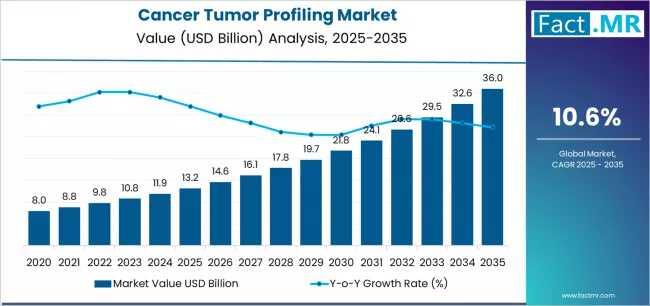
The global cancer tumor profiling market is positioned at the epicenter of an oncological revolution, projected to surge from USD 13.2 billion in 2025 to USD 36.0 billion by 2035. According to the latest strategic outlook from Fact.MR, the industry is expanding at a double-digit 10.6% CAGR, signaling a definitive shift from traditional "one-size-fits-all" chemotherapy toward highly personalized, biomarker-driven treatment paradigms.
The transition is being fueled by the rapid democratization of Next-Generation Sequencing (NGS), which has evolved from an academic research tool into a clinical necessity. As sequencing costs plummet and AI-driven interpretation tools mature, comprehensive genomic profiling is becoming the standard of care for identifying actionable mutations and matching patients with targeted therapies.
Get Access Report Sample :https://www.factmr.com/connectus/sample?flag=S&rep_id=11625
Quick Stats: Cancer Tumor Profiling Market at a Glance
- Market Value (2025E): USD 13.2 Billion
- Projected Value (2035F): USD 36.0 Billion
- Forecast CAGR:6% (2025–2035)
- Leading Technique: Genomics (38.5% share)
- Dominant Application: Personalized Cancer Medicine (41.2% share)
- Growth Leader: India (12.7% CAGR)
A Decade of Transformation: From Tissue to Liquid
The market’s expansion is divided into two distinct strategic phases:
Phase 1: 2025–2030 (The NGS Integration Phase)
The market is expected to climb to USD 21.7 billion by 2030. This era is defined by the widespread adoption of multi-gene panels in clinical labs, moving beyond single-gene testing. Genomics currently leads with a 38.5% share, supported by physician preference for broad molecular coverage that identifies both rare mutations and common biomarkers like PD-L1.
Phase 2: 2030–2035 (The Screening & Monitoring Phase)
Growth will accelerate toward USD 36.0 billion, driven by the maturity of Liquid Biopsy technologies. By 2035, liquid biopsies are expected to move from specialized monitoring to routine population-level screening, identifying malignancies at asymptomatic stages through non-invasive blood tests.
Technological Evolution: Multi-Omics and AI
Technique Dynamics:
While Genomics holds the lion's share, Proteomics (25.7%) and Metabolomics (18.3%) are emerging as critical complementary tools. Proteomics provides functional insights into protein expression—vital for immunotherapy response prediction—while Metabolomics offers mechanistic views into tumor metabolism and pathway vulnerabilities.
The AI Factor:
Artificial Intelligence is no longer optional. With the sheer volume of genomic data, AI-integrated diagnostic platforms (expected to hold an 18-22% share by 2030) are becoming the primary strategy for variant classification and therapy recommendation, drastically reducing diagnostic turnaround times.
Regional Performance: India and China Leading Growth
|
Country |
Projected CAGR |
Primary Growth Catalyst |
|
India |
12.7% |
Expansion of affordable sequencing infrastructure and precision oncology clinics. |
|
China |
12.4% |
Massive government investment in precision medicine and AI diagnostics. |
|
Brazil |
10.9% |
Public health screening partnerships and expanding oncology reference labs. |
|
Germany |
10.5% |
Robust biomarker research collaborations and national genomic programs. |
|
USA |
10.3% |
Comprehensive insurance coverage and FDA-cleared companion diagnostics. |
Strategic Drivers & Industry Challenges
Market Drivers:
- Precision Oncology Adoption: Targeted therapies now require validated companion diagnostics for eligibility.
- Cost Reductions: Lower sequencing costs are allowing community oncology practices to access advanced molecular profiling once reserved for academic centers.
- Tissue-Agnostic Approvals: Regulatory shifts toward treating cancers based on molecular features rather than the organ of origin.
Industry Restraints:
- Reimbursement Gaps: Uncertainty in payer coverage for large-scale comprehensive panels can limit volume scalability.
- Interpretation Complexity: The challenge of interpreting "variants of unknown significance" (VUS) continues to strain clinical decision-making.
Competitive Landscape
The market is led by technology titans and specialized diagnostic pioneers, including Illumina Inc., QIAGEN N.V., Exact Sciences Corporation, NeoGenomics Laboratories, and Guardant Health. Success in this space is increasingly dependent on providing "Complete Diagnostic Solutions"—integrating sequencing hardware with proprietary bioinformatics and clinical decision support systems.
To View Related Report:
Demand for Cancer Tumor Profiling in UK https://www.factmr.com/report/united-kingdom-cancer-tumor-profiling
Cancer Wounds Treatment Market https://www.factmr.com/report/cancer-wounds-treatment-market
Cancer Gene Therapy Market https://www.factmr.com/report/cancer-gene-therapy-market
Cancer Therapeutics Market https://www.factmr.com/report/4296/cancer-therapeutics-market
- Contact Us -
11140 Rockville Pike, Suite 400, Rockville,
MD 20852, United States
Tel: +1 (628) 251-1583 | sales@factmr.com
About Fact.MR
Fact.MR is a global market research and consulting firm, trusted by Fortune 500 companies and emerging businesses for reliable insights and strategic intelligence. With a presence across the U.S., UK, India, and Dubai, we deliver data-driven research and tailored consulting solutions across 30+ industries and 1,000+ markets. Backed by deep expertise and advanced analytics, Fact.MR helps organizations uncover opportunities, reduce risks, and make informed decisions for sustainable growth.

 English
 Arabic
 French
 Spanish
 Portuguese
 Deutsch
 Turkish
 Dutch
Dutch
 Italiano
 Romaian
 Portuguese (Brazil)
 Greek
Greek
