


Test Automation for Continuous Delivery: What to Run, When, and Why?
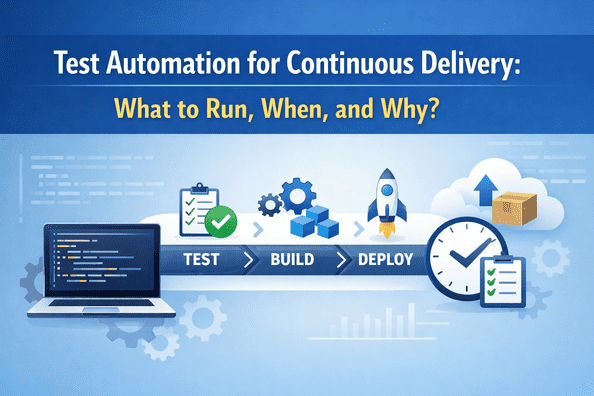
Continuous Delivery (CD) has become the standard for modern software teams. The promise is simple: deploy changes to production quickly, safely, and frequently. But achieving CD is not just about automation of deployments; it is about automating confidence.
Test automation is the backbone of this confidence. Without the right tests running at the right stages, continuous delivery becomes continuous risk. The challenge is not only what to test, but also when to test and why. Running every test on every change is impractical, while running too few tests exposes the team to regressions and production incidents.
This article explains a practical test automation strategy for continuous delivery, focusing on what to run, when to run it, and why it matters.
Why Test Automation Is Essential for Continuous Delivery
In CD, the pipeline is designed to deliver value continuously. To maintain speed, teams must reduce manual intervention. However, speed without quality is a disaster.
Test automation provides:
-
Fast feedback on code changes
-
Confidence that behavior is correct
-
Early detection of regressions
-
Reduced reliance on manual testing
-
Repeatable validation across environments
The goal of test automation in CD is not to catch every possible bug. It is to ensure that changes are safe to deploy, and that failures are detected early.
The Testing Pyramid for Continuous Delivery
A robust CD strategy uses the testing pyramid:
-
Unit tests at the base
-
Integration tests in the middle
-
End-to-end tests at the top
In continuous delivery, the majority of tests should be fast and reliable. Unit tests are the quickest and most cost-effective way to validate code behavior. Integration tests validate interactions between components. End-to-end tests validate user journeys and critical workflows.
The key is to use the right type of tests at the right stage in the pipeline.
What to Run Early: Fast Feedback Tests
The first stage of the pipeline should focus on fast feedback. These tests run immediately after code is committed and built.
1. Unit Tests
Unit tests validate the smallest units of code. They are fast and provide immediate feedback to developers. For continuous delivery, unit tests should run on every commit.
Why: Unit tests catch issues early before the code reaches shared branches.
2. Static Analysis and Linters
Static analysis tools detect code quality issues, security vulnerabilities, and style violations. They are fast and prevent problems from entering the codebase.
Why: Preventing issues early reduces rework and improves code quality.
3. Fast Integration Tests
Not all integration tests are slow. Fast integration tests validate interactions between small sets of components, such as service-to-database or API-to-service.
Why: These tests ensure components integrate correctly before moving to more expensive tests.
When to run:
-
On every pull request
-
On every commit to main branch
What to Run Next: Pipeline-Level Tests
Once the code passes fast tests, the pipeline should move to more comprehensive tests that take longer but provide higher confidence.
4. API Contract Tests
Contract tests validate that APIs adhere to agreed contracts. In CD, contract tests should run early to prevent breaking changes from reaching dependent services.
Why: APIs are shared dependencies. Contract failures can impact multiple teams and clients.
5. Component and Service Integration Tests
These tests validate interactions between services, databases, and external systems. They are more expensive than unit tests but are crucial for catching integration issues.
Why: Integration issues are the most common cause of production failures.
6. Security and Dependency Scans
Security scans and dependency vulnerability checks should run before deployment. They prevent known vulnerabilities from reaching production.
Why: Security issues can have severe business impact and must be caught early.
When to run:
-
On merge to main
-
Before deploying to staging or production
What to Run Late: High Confidence Tests
The final stage of the pipeline should validate the system as a whole. These tests are slower but critical for release readiness.
7. End-to-End Tests (Critical Workflows)
E2E tests validate complete user journeys such as login, purchase flow, or data export. These tests should be limited to the most critical workflows to keep pipeline time reasonable.
Why: E2E tests provide confidence that the system works from the user’s perspective.
8. Performance and Load Tests
Performance tests are not necessary on every change, but they are essential before major releases or when there are significant infrastructure changes.
Why: Performance issues can degrade user experience and cause outages.
9. Baseline Testing
Baseline testing captures the expected behavior of APIs and compares it over time. It is particularly useful in continuous delivery because it detects behavioral drift.
Why: Baseline testing prevents unintended behavior changes from slipping into production.
When to run:
-
Nightly builds
-
Before major releases
-
After significant architecture changes
The “Why” Behind Test Selection
Test selection should be based on risk and impact, not just completeness.
Here’s a simple framework:
-
High-risk changes: Run full pipeline
-
API changes: Run contract + integration + critical E2E
-
UI changes: Run UI E2E for impacted workflows
-
Bug fixes: Run targeted regression tests
-
Configuration changes: Run integration + smoke tests
This approach ensures that tests align with the nature of the change and the potential impact on production.
The Role of Test Automation in a Mature CD Pipeline
A mature CD pipeline should do more than run tests. It should:
-
Provide clear feedback on failures
-
Block deployments when critical tests fail
-
Allow fast rollback when needed
-
Track test coverage and flakiness
-
Support test selection and parallel execution
In high-frequency deployments, pipelines that run too long become a bottleneck. Test automation must be optimized for speed and relevance.
Managing Test Flakiness
Flaky tests are the silent killer of continuous delivery. They create noise and reduce confidence.
To manage flakiness:
-
Identify flaky tests and fix or remove them
-
Ensure tests are deterministic
-
Use stable test data and environments
-
Avoid dependencies on timing and external systems
A stable pipeline is a productive pipeline.
Final Thoughts
Continuous delivery is only sustainable when test automation provides fast, reliable confidence. The goal is not to run every test on every change, but to run the right tests at the right time.
By designing a pipeline that balances speed, coverage, and relevance, teams can ship frequently without sacrificing quality. Test automation becomes the engine that enables continuous delivery, not a bottleneck.

 English
 Arabic
 French
 Portuguese
 Deutsch
 Turkish
 Dutch
Dutch
 Italiano
 Russian
 Romaian
 Portuguese (Brazil)
 Greek
Greek
