


Agricultural Textiles Market Advancements in Crop Protection Solutions
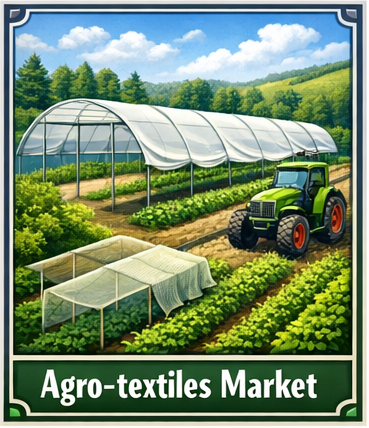
The Growing Role of Agro Textiles in Sustainable Agriculture
Modern agriculture is rapidly evolving as farmers seek solutions that improve crop yield while conserving resources. Among the innovations supporting this shift are agro textiles, specialized materials designed to protect crops, regulate microclimates, and enhance agricultural productivity. These materials—often called agrotextile fabrics or agricultural textiles—are now widely used in open-field farming, greenhouses, and controlled environment agriculture. Their ability to manage sunlight, moisture, and soil conditions has made them essential tools in climate-resilient farming systems.
Expanding Applications of Agricultural Textiles
The adoption of agricultural textiles has increased as farmers face challenges such as climate variability, soil degradation, and water scarcity. Products like shade net, anti-insect nets, mulch mats, and weed control fabric are widely used to create favorable growing conditions for crops. These materials help regulate temperature, reduce direct solar radiation, and maintain soil moisture—factors that directly influence plant growth and productivity.
One of the most widely used solutions is the shade net, which can reduce field temperatures by several degrees while still allowing sufficient sunlight for photosynthesis. By creating a controlled microclimate, shade nets enable farmers to cultivate crops in regions with extreme temperatures and increase the quality of produce.
Another essential component of agrotextile fabrics is weed control fabric. These permeable ground covers suppress weed growth while allowing water and air to penetrate the soil. As a result, farmers can reduce herbicide use and labor costs while preserving soil health. Such solutions are particularly valuable in sustainable and organic farming systems where chemical inputs are limited.
Sustainability and Smart Farming Trends
Recent innovations are pushing the agro textile industry toward environmentally friendly materials and precision agriculture integration. Biodegradable agrotextile fabrics made from natural fibers such as jute, coir, and cotton are gaining attention as farmers seek sustainable alternatives to synthetic plastics. These materials gradually decompose in soil, reducing long-term environmental impact while maintaining crop protection benefits.
In addition, the integration of agro textiles with precision farming technologies is opening new opportunities for smart agriculture. Modern agricultural textiles can support moisture retention, protect crops from extreme weather, and work alongside sensors that monitor soil conditions and plant health. Such innovations help optimize irrigation and fertilizer use, enabling farmers to increase productivity while minimizing resource consumption.
Agro textiles also contribute significantly to water conservation. Ground covers and mulch-based agrotextile fabrics can reduce evaporation rates by up to 50%, helping crops retain moisture in water-stressed regions. This capability is becoming increasingly important as agriculture accounts for a large share of global freshwater use.
Improving Crop Protection and Yield
Another major advantage of agricultural textiles is their ability to protect crops from environmental stress and pests. By forming a physical barrier, these materials shield plants from insects, birds, and harsh weather conditions such as hail or strong winds. At the same time, they maintain airflow and light transmission, ensuring that crops continue to grow under optimal conditions.
The combined use of shade net systems and weed control fabric in protected cultivation has significantly improved yields in horticulture, floriculture, and fruit farming. These agrotextile fabrics help maintain stable soil temperatures and reduce nutrient competition caused by weeds, allowing plants to develop stronger root systems and higher productivity.
As global food demand rises, these solutions are increasingly important for maximizing output from limited farmland. The ability of agro textiles to improve crop quality while reducing chemical inputs positions them as a key component of sustainable agricultural systems.
Market Outlook and Future Potential
The increasing adoption of agro textiles is reflected in strong market growth worldwide. The global agro textile market size was estimated at USD 4.62 billion in 2021 and is projected to reach USD 6.98 billion by 2030, growing at a CAGR of 4.7% from 2022 to 2030, according to Grand View Research.
This growth is driven by the expansion of protected cultivation, rising awareness of sustainable farming practices, and the growing need for climate-resilient agricultural technologies. As innovation continues in materials, design, and precision farming integration, agrotextile fabrics are expected to play an even greater role in improving food security and supporting modern agriculture worldwide.

 English
 Arabic
 French
 Spanish
 Portuguese
 Deutsch
 Dutch
Dutch
 Italiano
 Russian
 Romaian
 Portuguese (Brazil)
 Greek
Greek
