


Autonomous Tractors and Smart Technologies Transforming Farming
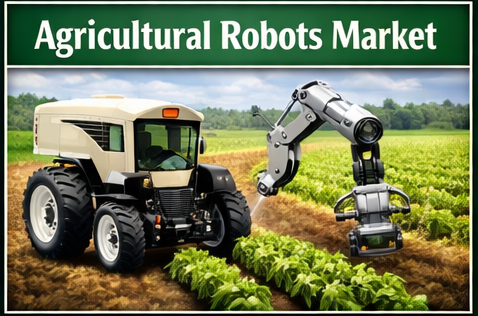
The Growing Role of Agricultural Robots in Modern Farming
Agriculture is undergoing a major technological transformation as automation and artificial intelligence become more integrated into farming practices. One of the most significant developments is the rise of agricultural robots, which are helping farmers improve productivity, reduce labor dependency, and manage crops more efficiently. As farms expand and labor shortages persist across many agricultural regions, the adoption of farm robots and advanced robotic farming equipment is accelerating worldwide.
Farmers today face increasing pressure to produce more food while managing limited resources such as land, water, and labor. Automation technologies are emerging as practical solutions to these challenges. From automated harvesting systems to crop monitoring drones, agricultural robots are reshaping traditional farming operations. These machines can work around the clock, collect precise field data, and perform tasks with a level of consistency that is difficult to achieve manually.
Automation Transforming Field Operations
One of the most impactful innovations in agricultural automation is the development of autonomous tractors. These self-driving machines use GPS navigation, sensors, and artificial intelligence to carry out tasks such as plowing, planting, and spraying with minimal human supervision. Unlike conventional tractors, autonomous tractors can operate continuously, allowing farmers to cover larger areas in less time and with greater precision.
In addition to tractors, a wide range of robotic farming equipment is being developed to handle specialized tasks. Robotic harvesters, for example, use computer vision systems to identify ripe fruits and vegetables and harvest them carefully without damaging crops. These technologies are particularly valuable in labor-intensive crops such as strawberries, tomatoes, and apples, where harvesting requires precision and speed.
Precision agriculture is another area where farm robots are delivering significant benefits. By combining sensors, machine learning, and automation, robotic systems can monitor soil conditions, crop health, and irrigation needs in real time. This allows farmers to make data-driven decisions that optimize resource usage and improve yields.
Weed-Control Robots Supporting Sustainable Farming
Sustainability has become a major focus for the agricultural industry, and weed-control robots are playing an important role in reducing reliance on chemical herbicides. These robots use cameras and AI-powered recognition systems to distinguish weeds from crops. Once identified, the machines remove or destroy weeds using mechanical tools, lasers, or targeted micro-spraying.
The adoption of weed-control robots is growing rapidly as farmers seek environmentally friendly alternatives to traditional weed management methods. These robotic systems not only reduce chemical usage but also improve crop health and soil quality over time. As sustainability regulations become stricter in many countries, the demand for such robotic farming equipment is expected to increase significantly.
Another advantage of agricultural robots is their ability to operate with high precision. By applying fertilizers, pesticides, or water only where needed, these systems minimize waste and lower production costs. This level of efficiency is becoming increasingly important as global agriculture faces rising input costs and environmental challenges.
Market Growth and Future Outlook
The commercial potential of agricultural robots is expanding rapidly as farmers recognize the long-term benefits of automation. Robotics manufacturers, technology companies, and agricultural equipment producers are investing heavily in research and development to create smarter and more adaptable machines.
A research report highlights the accelerating adoption of these technologies across global farming systems. The global agricultural robots market size was estimated at USD 14.74 billion in 2024 and is projected to reach USD 48.06 billion by 2030, growing at a CAGR of 23.0% from 2025 to 2030, according to Grand View Research. This rapid growth reflects increasing demand for farm robots, autonomous tractors, and advanced robotic farming equipment that can improve farm productivity and efficiency.
Looking ahead, the next generation of agricultural robots is expected to become even more intelligent and collaborative. Future systems may integrate artificial intelligence, cloud-based farm management platforms, and advanced sensor networks to create fully automated agricultural ecosystems. As technology continues to evolve, farm robots and weed-control robots will play an increasingly critical role in building a more productive, sustainable, and resilient global food system.

 English
 Arabic
 French
 Spanish
 Deutsch
 Turkish
 Dutch
Dutch
 Italiano
 Russian
 Romaian
 Portuguese (Brazil)
 Greek
Greek
