As a global manufacturer of overhead conductors and power cables, HNBF Power delivers a complete portfolio of aluminum-based conductors designed to meet the technical, safety, and reliability requirements of modern grid projects.
This guide explains how aluminum cable works, where it is used, and how engineers and procurement professionals can select the right solution for their projects.
Why Aluminum Cable Is the Preferred Choice for Power Utilities
Aluminum cable is widely adopted across transmission and distribution systems because of its practical advantages in real-world engineering environments.
Key performance benefits
-
Lightweight structure
Aluminum weighs roughly one-third of copper, significantly reducing tower loads and simplifying handling during installation.
-
High conductivity-to-weight ratio
While aluminum has lower conductivity per cross-section than copper, its lower density allows larger conductor sizes without excessive mechanical loading.
-
Lower total installed cost
Reduced material cost, lower transportation expense, and faster installation contribute to a more competitive project budget.
-
Excellent corrosion resistance
Properly designed aluminum conductors perform reliably in coastal, industrial, and high-humidity environments.
For power utilities and grid infrastructure projects, these advantages directly translate into improved constructability and optimized lifecycle cost.
Types of Aluminum Cables Manufactured by HNBF Power
HNBF Power supplies a comprehensive range of aluminum conductor solutions to support different voltage classes, mechanical requirements, and installation conditions.
AAC – All Aluminum Conductor
AAC cables are made entirely of aluminum strands and are commonly used in urban distribution networks where short spans and high conductivity are required.
AAAC – All Aluminum Alloy Conductor
AAAC cables utilize aluminum-magnesium-silicon alloys, providing improved tensile strength and better sag performance compared with AAC—ideal for longer spans and harsher climates.
ACSR – Aluminum Conductor Steel Reinforced
ACSR combines aluminum strands with a galvanized steel core, delivering high mechanical strength for long-distance transmission lines and high wind or ice load environments.
ABC – Aerial Bundled Cable
ABC systems use insulated aluminum conductors bundled together to improve safety, reduce power theft, and enhance reliability in densely populated areas.
LV Aluminum Power and Concentric Cables
For low-voltage distribution, service connections, and grounding applications, aluminum power cables and concentric cables provide an efficient and compliant solution.
Aluminum Cable Applications in Transmission & Distribution Projects
Aluminum cable is extensively deployed across:
-
Medium and high-voltage overhead transmission lines
-
Urban and rural distribution networks
-
Industrial power supply systems
-
Renewable energy interconnections
-
Utility service drops and secondary distribution
For EPC contractors and grid owners, aluminum conductors support both new build projects and network upgrades where reduced structure loading and fast deployment are essential.
Engineering Considerations When Selecting Aluminum Cable
Electrical design
Engineers must evaluate:
-
Continuous current rating
-
Short-circuit thermal capacity
-
Conductor resistance at operating temperature
-
Voltage drop limits
Mechanical performance
Mechanical design includes:
-
Span length and ruling span
-
Maximum allowable tension
-
Sag and creep behavior
-
Wind and ice load assumptions
Environmental conditions
Coastal regions, high pollution areas, and extreme temperature zones require careful material and surface treatment selection to ensure long-term reliability.
HNBF Power designs its aluminum cable products in compliance with major international standards such as International Electrotechnical Commission and ASTM International, ensuring compatibility with utility technical specifications worldwide.
Manufacturing Quality and Process Control at HNBF Power
At HNBF Power, aluminum cable manufacturing follows strict quality and traceability procedures throughout the production cycle:
-
Controlled aluminum rod sourcing and alloy composition
-
Precision wire drawing and stranding processes
-
Consistent conductor compaction and surface quality
-
Online diameter and resistance monitoring
-
Mechanical and electrical routine testing
Every production batch undergoes dimensional, tensile, and electrical verification to ensure that delivered cables meet both contractual and regulatory requirements.
This manufacturing discipline enables HNBF Power to serve utility operators, renewable developers, and industrial clients seeking long-term network reliability.
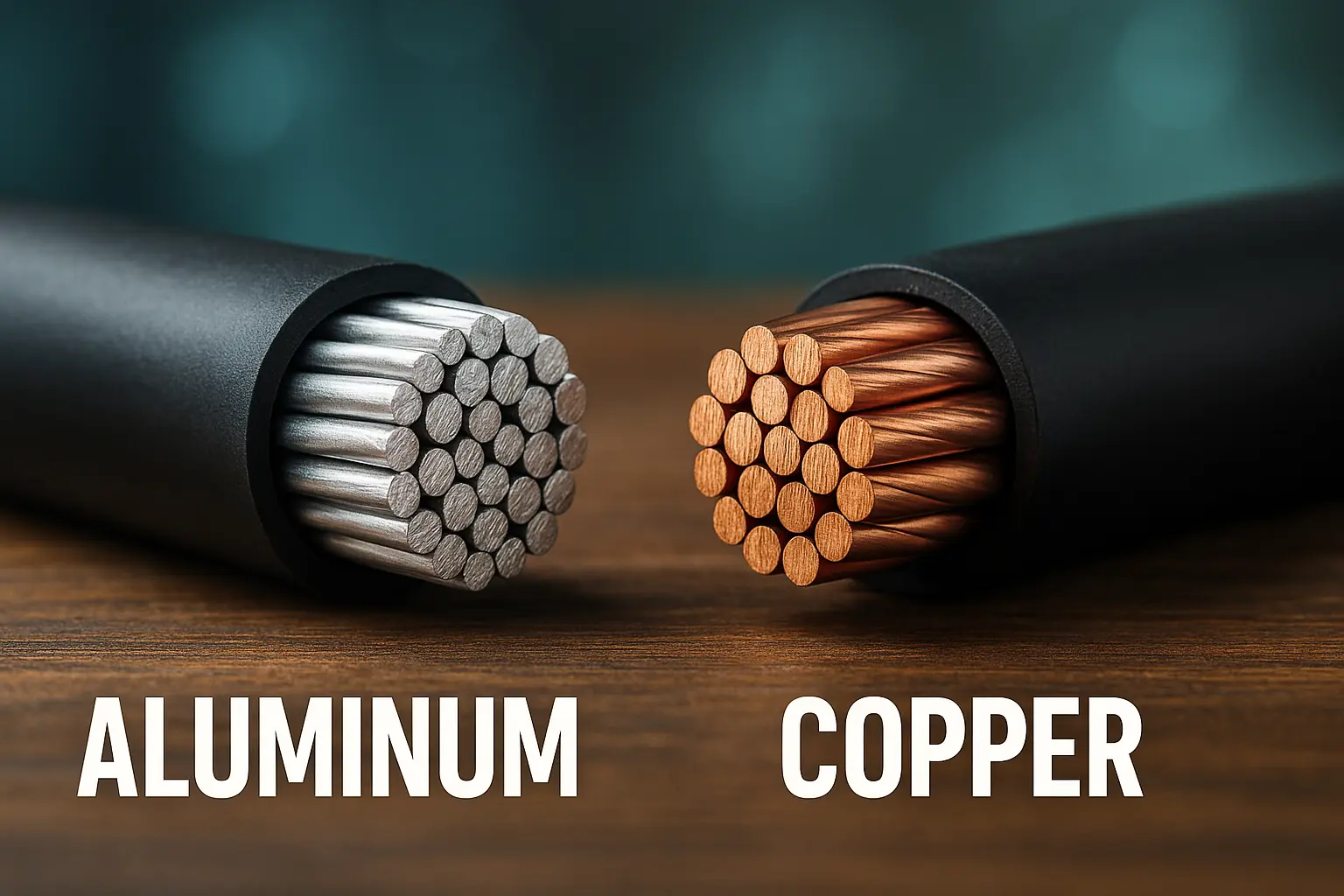
Aluminum Cable vs Copper Cable - Practical Comparison
From an engineering and procurement perspective, aluminum cable offers:
-
Lower material and logistics cost
-
Reduced installation manpower requirements
-
Easier handling for overhead construction
-
Lower structural reinforcement requirements
Copper remains suitable for compact installations with space constraints, but for most overhead and large-scale distribution projects, aluminum cable is the more efficient and scalable solution.
FAQs About Aluminum Cable
1. Is aluminum cable safe for power transmission networks?
Yes. When designed and installed correctly, aluminum cable is widely approved for transmission and distribution networks and has been used by utilities worldwide for decades.
2. Does aluminum cable have a shorter service life than copper?
No. Properly manufactured and installed aluminum conductors deliver comparable service life to copper, especially in overhead applications where corrosion control and mechanical performance are well managed.
3. Can aluminum cable be used in harsh environmental conditions?
Yes. AAAC and ACSR conductors are specifically designed for coastal, industrial, and high-load environments with improved corrosion resistance and mechanical stability.
4. Is aluminum cable suitable for renewable energy grid connections?
Absolutely. Aluminum cable is widely used for overhead transmission lines and collector systems connecting wind and solar projects to utility substations.
5. Can HNBF Power customize aluminum cable designs?
Yes. HNBF Power supports customized conductor designs, stranding constructions, and packaging solutions according to project-specific technical requirements.
Partner with HNBF Power for Reliable Aluminum Cable Solutions
For utilities, EPC contractors, and grid infrastructure developers, selecting the right aluminum cable supplier is critical for project success and long-term network reliability.
HNBF Power combines advanced manufacturing capability, international standard compliance, and global project experience to deliver dependable aluminum conductor solutions for modern power systems.
Contact HNBF Power today to discuss your project requirements and receive customized aluminum cable solutions tailored to your transmission and distribution applications.




 English
 Arabic
 French
 Spanish
 Portuguese
 Deutsch
 Turkish
 Dutch
Dutch
 Italiano
 Russian
 Romaian
 Greek
Greek
