


Causal AI: Understanding Cause-and-Effect for Smarter Decisions
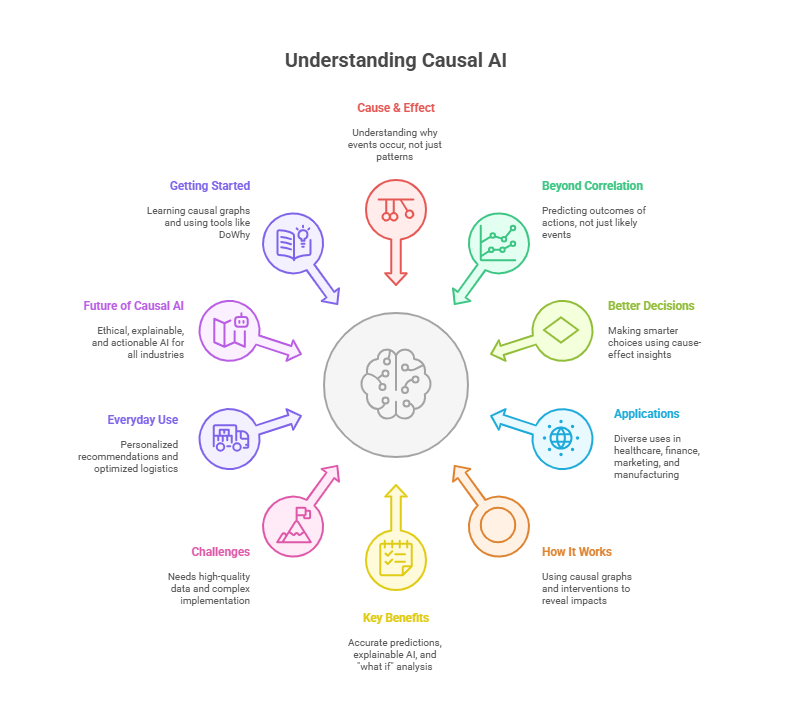
Causal AI is an advanced branch of artificial intelligence that focuses on understanding why events happen, not just what happens. Unlike traditional AI models that rely heavily on correlations found in large datasets, Causal AI seeks to identify cause-and-effect relationships. This capability allows systems to move beyond pattern recognition and make decisions that are more explainable, reliable, and aligned with real-world logic. As organizations increasingly depend on AI for critical decisions, the need for models that can reason like humans has made Causal AI an important evolution in the AI landscape.
At its core, Causal AI is built on the principles of causal reasoning, a concept long studied in fields such as statistics, economics, and philosophy. These systems use causal graphs, structural models, and counterfactual reasoning to analyze how changes in one variable directly influence another. For example, instead of simply observing that higher marketing spend correlates with increased sales, Causal AI can help determine whether the spending actually caused the increase or if other factors were responsible. This deeper insight enables more confident decision-making and strategic planning.
One of the most significant advantages of Causal AI is its ability to support explainable and transparent outcomes. Many traditional machine learning models operate as “black boxes,” making it difficult to understand how they arrive at specific predictions. Causal AI, by contrast, provides clear reasoning paths that explain why a particular outcome occurred. This transparency is especially valuable in regulated industries such as healthcare, finance, and insurance, where trust, accountability, and compliance are essential.
Causal AI also excels in scenario analysis and what-if simulations. By modeling causal relationships, organizations can test the potential impact of decisions before implementing them. For instance, businesses can evaluate how changes in pricing, supply chains, or customer engagement strategies might affect performance. This ability to simulate interventions helps reduce risk, optimize resource allocation, and improve long-term planning in uncertain environments.
Another important strength of Causal AI is its robustness in dynamic and changing conditions. Correlation-based models often fail when data patterns shift, leading to inaccurate predictions. Causal models, however, are more resilient because they are grounded in underlying mechanisms rather than surface-level patterns. This makes Causal AI particularly useful in environments where data is limited, biased, or constantly evolving, such as public policy design or scientific research.
Despite its benefits, Causal AI also presents challenges. Building accurate causal models requires domain expertise, high-quality data, and careful assumptions about how systems behave. Misidentified causal relationships can lead to flawed conclusions. However, ongoing advancements in tools, frameworks, and interdisciplinary research are making Causal AI more accessible and practical for real-world applications.
Causal AI represents a meaningful step toward more intelligent, human-like artificial intelligence. By focusing on cause-and-effect rather than simple correlation, it enables better explanations, stronger decisions, and more trustworthy outcomes. As organizations seek AI systems that can reason, adapt, and justify their actions, Causal AI is poised to play a critical role in shaping the future of intelligent technologies.

 English
 Arabic
 French
 Spanish
 Portuguese
 Deutsch
 Turkish
 Italiano
 Russian
 Romaian
 Portuguese (Brazil)
 Greek
Greek
