


Automotive Headliners Market Growth Outlook 2024 to 2034 at 4% CAGR
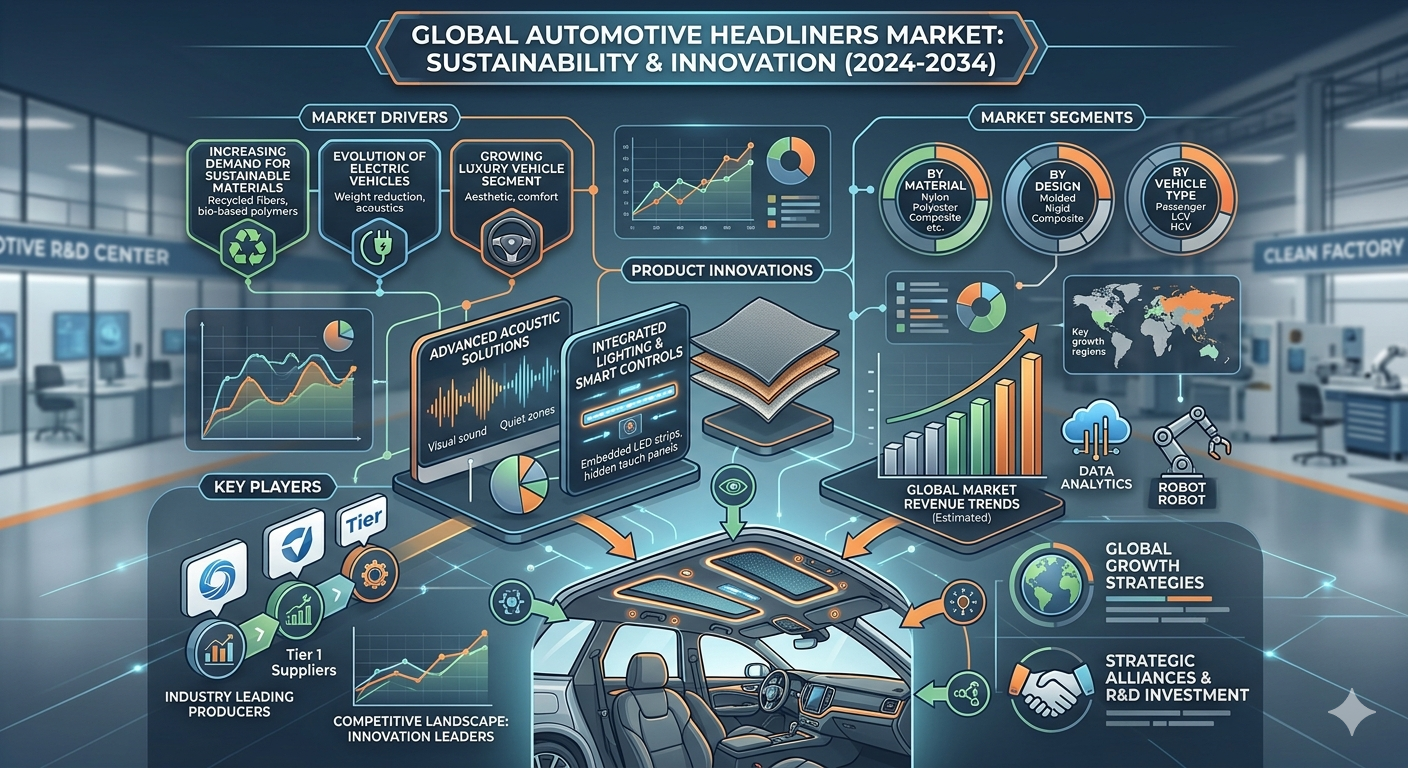
The global automotive headliner market is undergoing a significant aesthetic and functional transformation, projected to grow from US$ 9.9 billion in 2024 to US$ 14.6 billion by 2034. According to the latest industry analysis by Fact.MR, this steady expansion is being propelled by the rapid transition toward electric mobility and a burgeoning consumer appetite for personalized, luxury interiors.
As vehicle architecture evolves, the headliner—once a simple overhead fabric—is now a critical component for acoustic management, thermal insulation, and weight reduction. Manufacturers are increasingly pivoting toward plant-based woven textiles and recycled polymers to meet both stringent environmental regulations and the efficiency demands of long-range electric vehicles (EVs).
Get Access Report Sample : https://www.factmr.com/connectus/sample?flag=S&rep_id=414
Quick Stats: Automotive Headliner Market at a Glance
- Market Value (2024E): US$ 9.9 Billion
- Projected Value (2034F): US$ 14.6 Billion
- Global Growth Rate: 4% CAGR (2024–2034)
- Leading Segment: Soft-top Headliners (Projected US$ 7.6 Billion by 2034)
- S. Market Value (2034F): US$ 1.6 Billion
- South Korea Growth Rate:7% CAGR
Strategic Drivers: The "Green" Interior and Premiumization
The intersection of sustainability and luxury is redefining the material science behind modern vehicle cabins.
The Push for Low-Mass Solutions:
In the EV era, every gram matters. Manufacturers like The Woodbridge Group are leading the charge with innovations such as Stratas™ and GreenLite foam, which offer superior acoustical performance while significantly reducing weight compared to traditional fiberglass. These low-mass solutions allow OEMs to extend battery range without compromising on the "tactile experience" or interior quietness.
The Luxury Boom and Customization:
With luxury car sales in the U.S. jumping 19% in 2023, demand for high-end technical textiles from suppliers like Alcantara, Toray Industries, and Sage Automotive Interiors is surging. Modern consumers view the headliner as a canvas for personalization, driving a robust aftermarket for custom colors, textures, and even integrated tech, such as Oracle Lighting’s StarLINER ColorSHIFT fiber optic systems.
Regional Performance: North America and East Asia Lead the Charge
While North America remains a powerhouse for luxury and supercar customization, East Asia is cementing its role as the hub for sustainable manufacturing.
|
Country/Region |
2034 Forecast Value |
Growth Catalyst |
|
United States |
US$ 1.6 Billion |
Craze for supercars and a high rate of vehicle personalization/aftermarket upgrades. |
|
South Korea |
US$ 791.47 Million |
Rapid E-mobility adoption and supportive government policies for eco-friendly manufacturing. |
|
East Asia |
22.4% Share (2024) |
Massive OEM production footprint and integration of advanced autonomous vehicle tech. |
|
North America |
US$ 3.6 Billion |
Concentration of key premium and luxury vehicle manufacturers. |
Category Insights: Soft-Tops and Foam-Backed Cloth
- Soft-Top Headliners (4.3% CAGR): Dominating the market with an expected value of US$ 7.6 billion, soft-tops are favored for their superior sound absorption, easy installation, and design flexibility in premium vehicle segments.
- Foam-Backed Cloth (US$ 4.8 Billion by 2034): This material remains a staple due to its versatility across caravans, motor homes, and passenger cars. Its compatibility with various substrates like resinated cotton and hardboard ensures its continued dominance in the mid-sized and compact vehicle categories.
Innovation Spotlight: Organic Waste and Circular Economy
The industry is moving toward a circular model to navigate strict synthetic material regulations. A prime example is Grupo Antolin’s development of headliners produced from organic waste and recycled PET bottles, utilizing polyurethane derived from bio-sources. This shift not only reduces the carbon footprint but also appeals to the growing demographic of eco-conscious car buyers.
Analyst Opinion:
"The headliner is no longer just a 'ceiling'—it's a multi-functional acoustic barrier and a sustainability statement. As autonomous and shared mobility rise, the focus shifts to the passenger's tactile and sensory environment. We expect 'odor-control' and 'bio-integrated' fabrics to become the standard for high-end interiors by the end of the decade." — Senior Analyst, Fact.MR
Interactive Next Step
Would you like me to prepare a Material Sustainability Audit comparing the weight-to-acoustic performance of Recycled PET vs. Plant-Based Woven Textiles to help you identify the most cost-effective path toward your 2027 ESG targets?
To View Related Report:
Automotive Tubeless Tires Market https://www.factmr.com/report/103/automotive-tubeless-tires-market
Automotive Telematics Market https://www.factmr.com/report/45/automotive-telematics-market
Automotive Steering System Market https://www.factmr.com/report/43/automotive-steering-system-market
Automotive Seat Market https://www.factmr.com/report/42/automotive-seating-market
- Contact Us -
11140 Rockville Pike, Suite 400, Rockville,
MD 20852, United States
Tel: +1 (628) 251-1583 | sales@factmr.com
About Fact.MR
Fact.MR is a global market research and consulting firm, trusted by Fortune 500 companies and emerging businesses for reliable insights and strategic intelligence. With a presence across the U.S., UK, India, and Dubai, we deliver data-driven research and tailored consulting solutions across 30+ industries and 1,000+ markets. Backed by deep expertise and advanced analytics, Fact.MR helps organizations uncover opportunities, reduce risks, and make informed decisions for sustainable growth.

 English
 Arabic
 French
 Portuguese
 Deutsch
 Turkish
 Dutch
Dutch
 Italiano
 Russian
 Romaian
 Portuguese (Brazil)
 Greek
Greek
