


What Does a Commercial General Contractor Actually Do? A Plain-English Guide for Iowa Business Owners
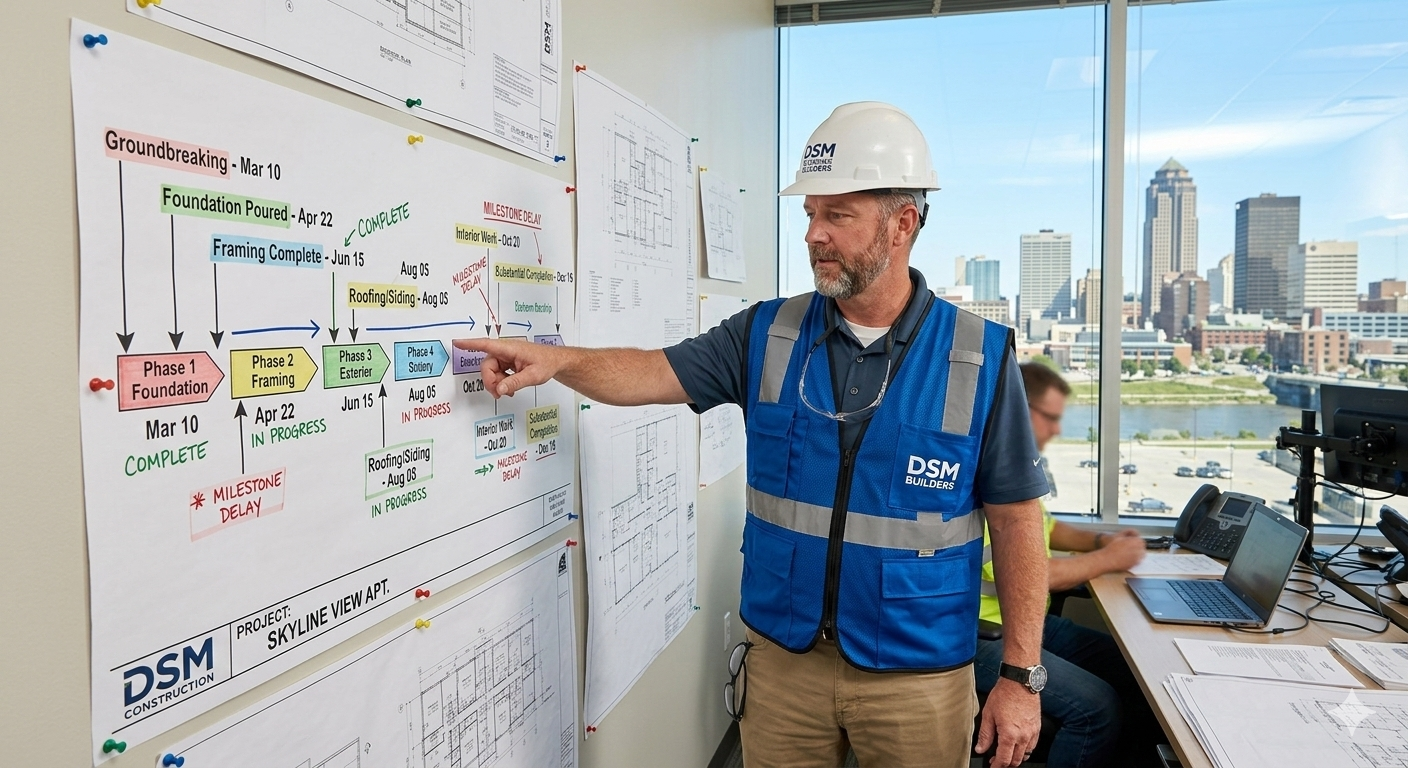
A commercial general contractor is the person — or company — responsible for turning a set of construction plans into a finished building or renovated space. They manage the entire construction process: hiring and coordinating subcontractors, pulling permits, scheduling inspections, controlling costs, and keeping the project moving from start to finish.
That definition sounds simple. The actual job is anything but.
Most Iowa business owners I talk to — whether they're building a new office in Ankeny, renovating a retail space in West Des Moines, or expanding a warehouse in Waukee — have a general sense of what a contractor does, but not a clear picture of what they're actually managing day-to-day. That gap leads to misaligned expectations, communication problems, and sometimes expensive surprises.
This guide breaks it down plainly. If you're planning a commercial project anywhere in Central Iowa, understanding what a general contractor actually does — and what to look for when hiring one — is one of the most valuable things you can do before the project starts.
The team at Happe Commercial works with Iowa business owners from the earliest planning stages through project completion, and the questions below are ones we hear regularly.
The Core Role: What a General Contractor Is Actually Responsible For
A commercial general contractor (GC) is the primary point of accountability on a construction project. They hold the main contract with the owner, and they're responsible for everything that happens on the job site — whether they're doing that work directly or through subcontractors.
Here's what that looks like in practice:
- Subcontractor management — The GC selects, hires, coordinates, and supervises the subcontractors who do the specialized work: electricians, plumbers, HVAC technicians, drywall crews, flooring installers, and others.
- Permit and inspection management — The GC pulls the building permits, schedules required inspections, and makes sure the project meets code at every phase.
- Schedule management — The GC builds the construction schedule and keeps it moving. When one trade finishes, the next one needs to be ready. That sequencing is the GC's job.
- Budget management — The GC tracks costs against the contract, manages change orders, pays subcontractors, and reports to the owner on budget status.
- Safety — On commercial projects, the GC is responsible for job site safety. OSHA compliance, site security, and protection of adjacent occupied spaces all fall under the GC's responsibility.
- Quality control — The GC reviews work as it's completed, ensures it meets the specifications in the drawings, and manages the punch list at the end of the project.
- Owner communication — The GC is the owner's primary contact throughout construction. Regular updates, RFI (request for information) responses, and change order conversations all run through the GC.
In short: the general contractor is the person who takes responsibility for the construction process so the owner doesn't have to manage it directly.
What a GC Does Before Construction Even Starts
A lot of the most valuable work a general contractor does happens before a single wall goes up. This preconstruction phase is often underappreciated — and it's where experienced contractors separate themselves from less experienced ones.
Preconstruction Services
During preconstruction, a GC typically:
→ Reviews the project drawings and specifications for constructability issues → Prepares a detailed cost estimate based on the actual scope of work → Identifies long-lead materials and equipment that need to be ordered early → Develops the construction schedule → Solicits subcontractor bids and evaluates them for completeness and competitiveness → Works with the design team to identify value engineering opportunities → Assists with the permit application process
This phase is where a good GC adds real financial value. Catching a design issue during preconstruction costs very little to fix. Catching it during construction — when walls are already framed and mechanical rough-in is in progress — can cost tens of thousands of dollars.
Bid Review and Subcontractor Selection
On most commercial projects, the general contractor doesn't self-perform all the work. They hire licensed subcontractors for the specialized trades. The GC's job during bidding is to get competitive pricing from qualified subs, review those bids for completeness, and select the team that delivers the best combination of price, experience, and reliability.
A common mistake owners make is assuming that the lowest subcontractor bid is always the best choice. It often isn't. A sub that bids low and then issues change orders throughout the project can end up costing more than a sub that priced the work correctly from the beginning. Experienced GCs know which subs in the Des Moines market price work accurately and perform reliably.
What a GC Does During Construction
Once the permit is issued and the project is underway, the GC's role shifts to execution and coordination. This is where the day-to-day management work happens.
Trade Coordination
Commercial construction involves multiple trades working in a sequence — and often overlapping each other on tight schedules. The GC's superintendent manages this on the job site daily.
A typical construction sequence looks like this:
- Demolition of existing conditions
- Rough framing and structural work
- Rough mechanical, electrical, and plumbing (MEP)
- Inspections at rough-in stage
- Insulation
- Drywall and ceiling systems
- MEP trim-out (fixtures, devices, equipment connections)
- Flooring, paint, and finishes
- Doors, hardware, and specialties
- Final inspections and punch list
Each phase depends on the one before it. If the electrician falls behind on rough-in, the drywall crew can't start. If drywall gets delayed, painting gets pushed, and so does flooring. The GC manages this sequence proactively — not reactively — by staying ahead of each trade's needs.
Managing Change Orders
Change orders are modifications to the original scope of work. They happen on almost every project — because of owner-requested changes, unforeseen conditions discovered during construction, or design details that need to be resolved in the field.
A well-run GC process handles change orders by:
- Identifying the change clearly in writing
- Pricing the cost and schedule impact before the work proceeds
- Getting owner approval in writing before work begins
- Documenting everything for the project record
The biggest change order problems I see on commercial projects happen when work gets done verbally — a contractor says "we'll figure it out later" and the owner agrees to proceed without a written cost. "Later" always produces a dispute. A GC who manages change orders rigorously is doing you a favor even when it feels like paperwork.
Inspections and Code Compliance
On commercial projects in Iowa, multiple inspections are required at different stages of construction. The GC schedules these with the local building department — Des Moines, Ankeny, West Des Moines, Waukee, and each municipality have their own inspection processes.
Required inspections typically include:
- Footing and foundation (for ground-up projects)
- Rough framing
- Rough MEP (mechanical, electrical, plumbing)
- Insulation
- Final building inspection
- Any specialty inspections (fire suppression, elevator, health department for food service)
Failing an inspection — or missing one — causes real schedule delays. Part of the GC's job is making sure the project is ready before an inspection is called, not hoping it passes.
The Difference Between a Commercial GC and a Residential Contractor
This distinction matters more than most Iowa business owners realize. Commercial construction is a different business from residential construction — different codes, different contract structures, different insurance requirements, and different complexity levels.
Licensing and insurance: Commercial GCs carry significantly higher insurance limits than residential contractors. Commercial general liability and builders risk coverage requirements are higher because the projects are larger and the potential exposure is greater.
Code requirements: Commercial projects fall under the International Building Code (IBC) and related standards. Residential projects use the International Residential Code (IRC). They're different code bodies with different requirements for structure, fire protection, egress, accessibility (ADA), and mechanical systems.
Project complexity: A commercial renovation in Des Moines typically involves coordinating multiple licensed subcontractors, managing lien waivers, submitting certified payroll on publicly funded projects, and working within occupied buildings while maintaining code-compliant temporary conditions.
Contract structure: Commercial contracts — AIA documents, owner-furnished agreements, design-build contracts — have different legal frameworks than residential contracts. Understanding these documents and managing risk within them is part of commercial GC expertise.
Hiring a residential contractor for a commercial project because they're cheaper or available faster is a risk that Iowa business owners sometimes take. It usually costs more in the end.
How GC Fees Work: What You're Actually Paying For
The way general contractors charge varies by project type and delivery method. Here are the most common structures:
Lump sum (fixed price): The GC provides a fixed price for the defined scope of work. Cost risk above that number is the GC's, not the owner's. This works best when drawings are complete and scope is well-defined.
Cost-plus with a fee: The owner pays actual construction costs plus a GC fee (typically 8 to 15% of construction cost). This is common in design-build projects where scope evolves during design. More transparent on costs, but the owner carries more cost risk.
Guaranteed maximum price (GMP): A cost-plus structure with a ceiling. The GC is reimbursed for actual costs up to the GMP, and any overrun above the GMP is the GC's problem. Savings below the GMP may be shared between owner and GC depending on the agreement.
GC fee as a percentage of construction cost: On a $1 million commercial renovation in Des Moines, a GC fee typically runs $80,000 to $150,000 depending on project complexity and delivery method. That fee covers the GC's overhead, project management, superintendent time, insurance, bonding, and profit.
For a full look at what construction costs look like in the Des Moines market by project type, our breakdown of commercial construction costs in Des Moines for 2025 provides current pricing context.
What to Look for When Hiring a Commercial GC in Iowa
Not all general contractors are equal — and the difference between a well-run project and a troubled one often comes down to who you hired and how clearly expectations were set from the beginning.
Here are the things I'd evaluate before hiring a commercial GC in Central Iowa:
a) Local experience in your project type A GC with a strong track record on office renovations may not have the same depth on restaurant construction or industrial builds. Ask specifically about projects similar to yours — in scope, size, and building type.
b) Subcontractor relationships The quality of a GC's subcontractor network matters as much as the GC themselves. Ask who they typically use for electrical, mechanical, and drywall work — and whether those subs are available and familiar with the GC's process.
c) Project management approach Ask how they communicate during construction. How often will you receive updates? Who is your day-to-day contact? How are change orders handled? A GC who can answer these questions clearly has a real process. One who gives vague answers probably doesn't.
d) References from recent projects Call the references. Ask about schedule performance, communication quality, and how problems were handled. A GC who consistently delivers on schedule and communicates proactively shows up clearly in reference conversations.
e) Financial stability Commercial GCs manage significant cash flow — paying subcontractors, purchasing materials, and managing project costs for months before final payment. A GC with financial problems can create serious problems for your project. It's reasonable to ask about bonding capacity and financial stability on larger projects.
💬 Something Worth Knowing Before You Hire
"One of the most consistent patterns I've seen over the years is that the owners who have the best project experiences are the ones who treated contractor selection like a real business decision — not just a price comparison. They interviewed multiple contractors, asked detailed questions about process and subcontractors, checked references, and made sure the person they'd be working with was someone they trusted to make good decisions. The bid amount matters. But it's rarely the most important factor."
Pros and Cons of Hiring a General Contractor vs. Managing Construction Yourself
Some Iowa business owners consider managing their own renovation — hiring subcontractors directly to save the GC fee. Here's an honest look at how that typically plays out.
Hiring a General Contractor
✔ Single point of accountability for the entire project ✔ Experienced coordination of multiple trades and schedules ✔ Permit management and code compliance handled by professionals ✔ Change order documentation and cost control managed by the GC ✔ Access to established subcontractor relationships and pricing
✔ GC fee adds 8 to 15% to construction cost ✔ Less direct control over subcontractor selection in some cases
Self-Managing (Owner as General Contractor)
✔ Potential cost savings by eliminating GC markup ✔ Direct relationships with each subcontractor
✔ Requires significant time investment — this is effectively a part-time job ✔ No established subcontractor relationships or leverage on pricing ✔ Permit management and inspection scheduling falls to you ✔ When trades conflict or fall behind, you're the one solving it ✔ Change order disputes are between you and each individual sub
In my experience, owner-managed commercial projects almost always end up taking longer and costing more than they would have with a GC. The GC fee looks like savings until you account for your time, the delays from coordination gaps, and the subcontractor pricing you didn't get because you're a one-time customer.
Ready to Talk to a Commercial General Contractor in Iowa?
If you're planning a commercial project in Des Moines, Ankeny, West Des Moines, Waukee, Urbandale, or anywhere in Central Iowa, the right time to start the contractor conversation is earlier than you think — ideally before your design is finalized.
Happe Commercial works as a commercial general contractor across the Iowa market on office renovations, retail and restaurant build-outs, industrial projects, tenant improvements, and ground-up construction. We work with business owners who are just starting to think through a project as readily as we work with those who have drawings in hand.
If you'd like to understand what your project will take — in time, in cost, and in process — reach out through Happe Commercial to start the conversation.
Frequently Asked Questions
What is a commercial general contractor responsible for on a project? A commercial general contractor manages the entire construction process — hiring and coordinating subcontractors, pulling permits, scheduling inspections, controlling costs, and serving as the owner's primary point of contact from start to finish.
How is a commercial general contractor different from a residential contractor? Commercial GCs work under different building codes, carry higher insurance requirements, manage more complex contract structures, and coordinate larger teams of licensed specialty subcontractors than residential contractors typically handle.
How much does a commercial general contractor charge in Iowa? GC fees in the Des Moines market typically run 8 to 15% of total construction cost, depending on project type, delivery method, and scope complexity.
When should I bring a general contractor into my project? Ideally during the design phase — not after drawings are complete — so the contractor can provide cost feedback, identify long-lead items, and catch constructability issues before they become expensive problems.
What is the difference between a GC fee and a lump sum contract? A lump sum contract gives you a fixed price for a defined scope of work, while a GC fee structure reimburses actual costs plus a percentage fee — which is more common on design-build projects where scope evolves during design.
Can I manage my own commercial renovation without a general contractor? Technically yes, but owner-managed commercial projects almost always take longer and end up costing more than expected because of coordination gaps, subcontractor pricing disadvantages, and the significant time required to manage trades effectively.
Do commercial general contractors pull their own permits in Iowa? Yes — on commercial projects, the general contractor typically pulls the building permit and is the licensed party of record responsible for code compliance throughout the construction process.

 Arabic
 French
 Spanish
 Portuguese
 Deutsch
 Turkish
 Dutch
Dutch
 Italiano
 Russian
 Romaian
 Portuguese (Brazil)
 Greek
Greek
