


Global Military Tank Containers Market Forecast by 2034: Market Size, Segmentation, and Competitive Landscape
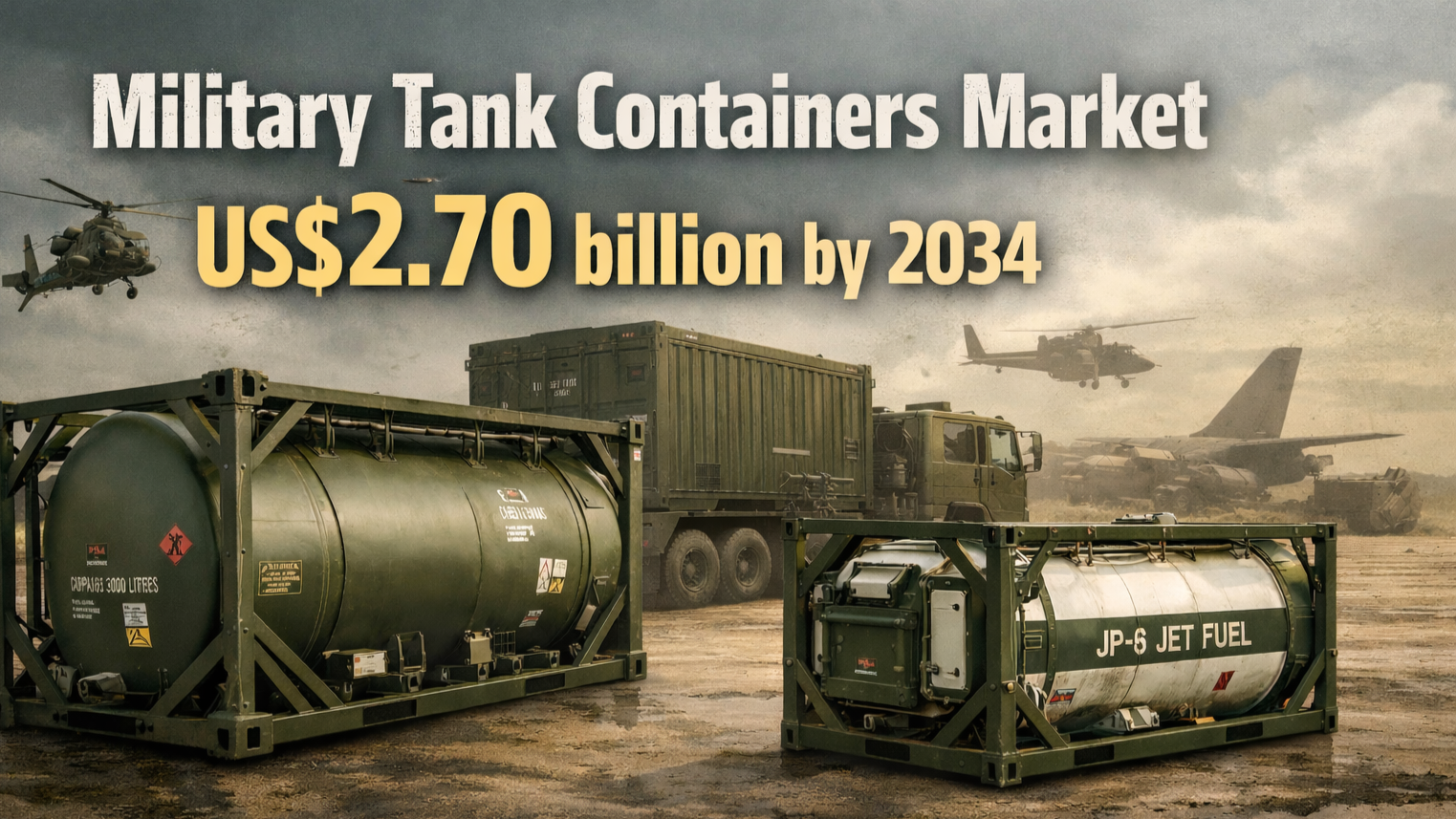
Military tank containers are specialized intermodal units designed for the secure transport and storage of liquids like fuel, water, chemicals, and hazardous materials in military logistics.
Military Tank Containers Market Size and Share
The military tank containers market size is projected to reach US$2.70 billion by 2034 from US$1.32 billion in 2025. The market is anticipated to register a CAGR of 12.67% during the forecast period 2026–2034.
The military tank containers market is witnessing strong growth momentum as defense forces worldwide modernize their logistics infrastructure to support expeditionary and high-intensity operations. Military tank containers are specialized ISO-compliant units designed for the safe storage and transportation of critical liquids such as fuel and potable water across multimodal platforms, including road, rail, sea, and airlift. Their modular nature enables rapid deployment, faster setup of Forward Operating Bases (FOBs), and efficient replenishment of frontline units.
Between 2025 and 2034, the market is projected to grow significantly, driven by rising global defense spending, increasing geopolitical tensions, and the operational shift toward containerized logistics. Armed forces are increasingly replacing traditional fuel bladders and fixed storage tanks with standardized tank containers due to their durability, stackability, and interoperability with allied forces. The emphasis on expeditionary warfare and joint operations under NATO and allied frameworks further accelerates the adoption of standardized tank container systems.
Market Drivers and Opportunities
One of the primary growth drivers is the rising demand for secure and efficient liquid logistics. Modern combat operations depend heavily on uninterrupted fuel and water supply to support armored vehicles, aircraft, and deployed troops. Tank containers ensure the safe transport of volatile fuels and potable water under extreme climatic and operational conditions. Their ruggedized construction, often compliant with ISO, CSC, and MIL-STD standards, improves survivability and reliability in hostile environments.
Another key driver is the modernization of military supply chains. Defense agencies are transitioning toward intelligent logistics systems, integrating telemetry and IoT-enabled monitoring into containers to provide real-time visibility of fuel and water levels. This digitalization reduces operational risks, improves forecasting accuracy, and minimizes the likelihood of supply chain disruptions during prolonged deployments.
From an opportunity standpoint, the development of advanced lightweight materials such as corrosion-resistant aluminium alloys and composite linings is improving payload efficiency and air mobility. These innovations are especially valuable for rapid reaction forces and airborne units with strict payload limitations. Additionally, growing interest in renewable and alternative fuels under “green defense” initiatives is creating demand for tank containers capable of safely handling hydrogen, biofuels, and other alternative energy sources.
Download PDF Copy- https://www.theinsightpartners.com/sample/TIPTE100000689
Segmentation Insights
By material, stainless steel dominates due to its superior corrosion resistance and chemical stability, making it suitable for high-grade aviation fuels and potable water. Aluminium alloy containers are gaining traction among air-mobile and expeditionary units due to their lightweight properties.
By container type, reefer (thermal-controlled) tank containers are increasingly deployed in extreme climates to prevent fuel degradation and water freezing, while dry/standard tank containers remain the most widely used for routine bulk liquid transport.
By supplies, fuel accounts for the largest market share, reflecting the high operational fuel demand of mechanized and air forces. The water segment remains critical for humanitarian missions, disaster response, and sustaining deployed forces.
By end user, military organizations represent the largest demand segment, while homeland security agencies utilize tank containers for disaster relief operations, border security missions, and emergency preparedness.
Regional Insights
North America and Europe currently dominate the market due to sustained defense investments, NATO interoperability requirements, and large-scale logistics modernization programs. Asia Pacific is expected to witness the fastest growth as countries such as China, India, and Japan expand expeditionary capabilities and invest in mobile military infrastructure. The Middle East and Africa region also shows strong demand growth driven by security concerns and regional defense modernization initiatives.
Key Players (Bullet Points)
- WEW Container System GmbH – Specializes in customized military-grade ISO tank containers with ruggedized designs for harsh environments.
- Klinge Corporation – Known for refrigerated and dry tank container solutions with advanced thermal and power efficiency features.
- Krampitz Tanksystem GmbH – Focuses on fuel storage, refueling systems, and mobile tank solutions for military and civil defense applications.
- SEA BOX, Inc. – Provides highly customized containerized systems for military logistics and expeditionary operations.
- AMA S.p.A – Manufactures specialized tanks and containerized storage systems for defense and industrial logistics.
- ANCORA Sp. z o.o. – Develops rugged container solutions for transport and storage of liquids in defense operations.
- VARIEL, a. s. – Supplies customized military containers with a focus on durability and operational flexibility.
- Eurotainer SA – Provides leasing and logistics support for tank containers used in defense and commercial sectors.
- LAVA Engineering Company – Expanding presence in Asia with containerized fuel and water logistics solutions for armed forces.
Future Outlook
The future outlook for the military tank containers market remains highly positive through 2034, supported by rising defense budgets, the evolution of expeditionary warfare doctrines, and the integration of smart logistics technologies. Future demand will be shaped by increased adoption of IoT-enabled monitoring systems, lightweight materials for air mobility, and multi-purpose tank designs capable of handling diverse fuels, including alternative energy sources. As armed forces prioritize rapid deployment, interoperability, and sustainability, military tank containers will continue to play a strategic role in ensuring resilient and efficient battlefield logistics across global defense operations.
Other Reports-

 Arabic
 French
 Spanish
 Portuguese
 Deutsch
 Turkish
 Dutch
Dutch
 Italiano
 Russian
 Romaian
 Portuguese (Brazil)
 Greek
Greek
